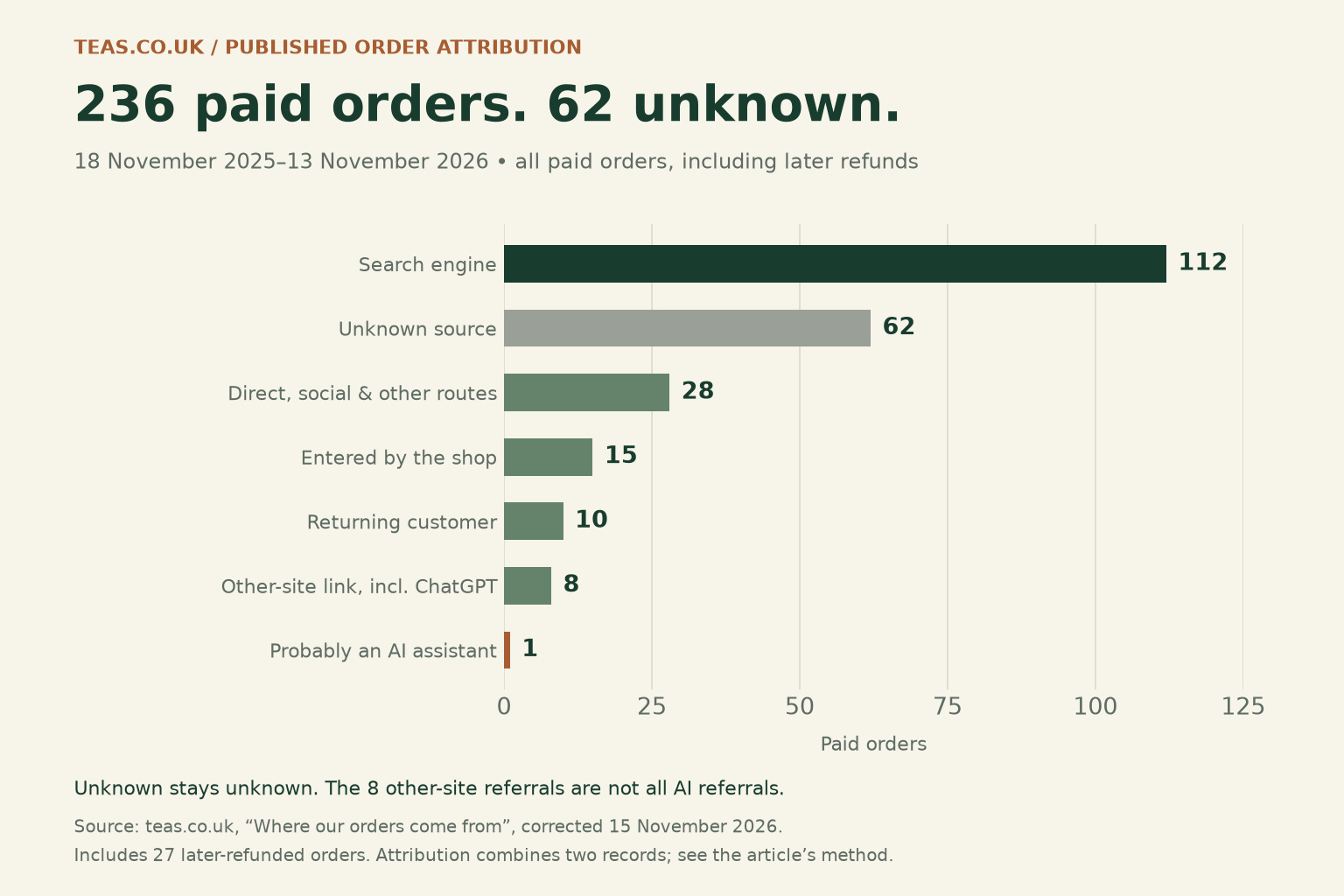
Traffic figures are easy to publish. Where orders came from is harder, because the honest answer includes a large "we don't know". Ours does too. This is the full count of every paid order, taken on 13 November 2026 from two records: the origin record on each order placed since 10 May 2026, and, for the 75 orders the shop took on its first version before that, what the shop platform itself recorded at checkout.
The count
| Where the order came from | 10 May to 13 November 2026 | First version, 18 November 2025 to 9 May 2026 | All paid orders |
|---|---|---|---|
| A search engine | 71 | 41 | 112 |
| We could not tell | 47 | 15 | 62 |
| Typed our address, social media and other routes | 9 | 19 | 28 |
| Orders we entered ourselves | 15 | 0 | 15 |
| A returning customer | 10 | not recorded | 10 |
| A link from another site, including ChatGPT | 8 | 0 | 8 |
| Probably an AI assistant | 1 | 0 | 1 |
| Paid orders | 161 | 75 | 236 |
Each column adds up to its total. The two columns come from different records: the first version's column is what the shop platform wrote at checkout, which it did only when the buyer had accepted cookies, and it had no way to mark a returning customer. Twenty seven of the 236 orders were later refunded, 26 of them since 10 May; they stay in the count, because the question here is what brought the customer, not what we kept.
Google sends most of them
Of the 112 orders that began with a search, 101 came from Google, 8 from DuckDuckGo, 2 from Ecosia and one from Bing. Google has also been sending more visitors. Search Console recorded 26,445 clicks to teas.co.uk between 11 August and 10 November. In the first four weeks of that period the average was 160 clicks a day. In the last four weeks it was 468.
The orders followed. September brought 41 paid orders and October 36, our two best months so far. No advertising was bought for any of it.
ChatGPT sent five
Five orders arrived on a link that ChatGPT showed to someone, carrying ChatGPT's own tag. For four of them our order record took the tag from the customer's first recorded visit, which began less than an hour before the order; for the fifth our server saw it on the landing request. Two of the five were later refunded. One more order probably came from an AI assistant, through a site that serves both an assistant and ordinary search, so we grade it as probable and no higher. And one customer told us on the thank you page that an assistant had sent them, although our own records show a search engine for that order.
That makes seven orders with some AI evidence, all since 10 May 2026; the shop platform's record of the first version shows none. It is a small number, and we would rather publish a small true number than a large hopeful one. The five tagged orders are a lower bound of orders that arrived on an assistant's tagged link. The other two are not a lower bound of anything, and someone who reads an AI answer and then types our address, or searches for us, leaves no AI trace at all. The rule behind each figure is in Room 02 of Under the Hood.
The 62 we cannot explain
Our pages are served from a cache close to the reader, so the first page of a visit often never reaches our server, and without a tag on the link there is nothing to read later. Where that happens the order record says "unknown" and gives the reason. On the first version, the shop platform wrote nothing when the buyer had not accepted cookies. We do not guess, and we do not fill the gap with a favourable assumption.
What we are doing with this
Most people find us through a Tea Wiki guide, not a product page. So this week more than 380 guides gained a shortlist of teas that match what the guide is about, drawn from the 402 products and 40 brands in the range. A guide about hard water now shows the tea blended for it. A guide about taking tea on a plane now shows instant tea that needs no milk.
We also found that Google was still sending visitors to pages for products we no longer sell, which answered "page not found". Those addresses now lead to the closest thing we do sell. And the teas that are hard to find elsewhere have a shelf of their own.
What this count cannot tell you
This count answers one question: what brought each customer here. It does not say whether they got the tea that suited them, whether a suggested extra was worth it, whether they came back because the advice was good, or whether a recommendation led to a return that could have been avoided. Those are different questions and we have not measured them yet. A purchase is not proof the customer was happy, and a link that brought a visit is not proof it caused the order. If we start counting outcomes, they will be a separate series with their own rules and dates, kept apart from these figures. What would count, and what is untested, is listed in What could prove me wrong.
We will run this count again and publish it, whichever way the numbers move.
Related reading: Most of the web is closing the door to AI. We opened ours. · The giant can outspend a tea shop and still lose
Method: every paid order (completed, processing or later refunded) placed on teas.co.uk from the first on 18 November 2025 to 13 November 2026. From 10 May 2026, when our own visit records begin, the origin record on each order; that record began on 6 October 2026 and was reconstructed back to 10 May from records we already held. Before 10 May 2026, the attribution fields the shop platform wrote at checkout. Totals only; no single order is described. Search figures are from Google Search Console, 11 August to 10 November 2026.
Corrected 15 November 2026. This article first counted only the 161 orders since 10 May 2026 and left out the 75 the shop took on its first version; its title said 161 orders. It also said our server saw ChatGPT's tag "in the same visit", where the order record read the customer's first recorded visit, and it called all seven AI orders "a floor", which holds only for the five tagged ones.
Read next: What could prove me wrong