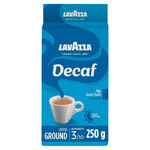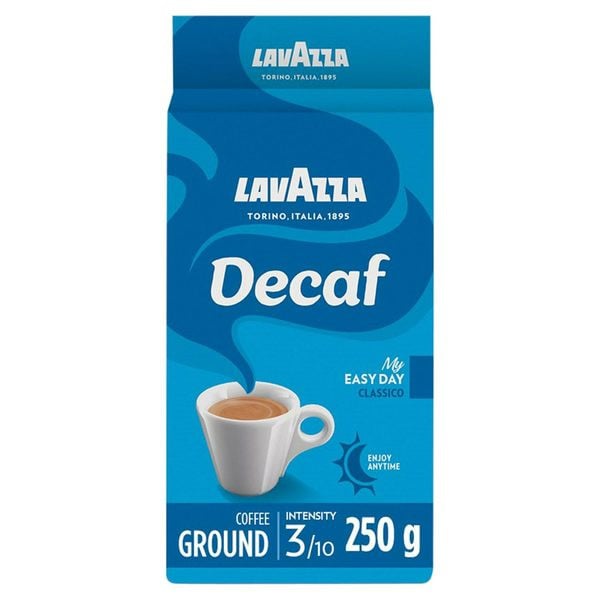
Lavazza Decaf Classico Ground Coffee, 250g
Lavazza's decaffeinated Classico, ground: a medium roast, intensity 3 of 10 per Lavazza, with delicate fruity and dried-fruit notes and a silky texture, decaffeinated with carbon dioxide. It suits a moka pot, a filter or a cafetiere, and still contains a trace of caffeine.
Lavazza Decaf Classico Ground Coffee, in brief.
Lavazza Decaf Classico Ground Coffee is Lavazza's decaffeinated Classico in a 250g vacuum brick, ground for moka pots and home espresso baskets: a medium roast with delicate fruity and dried-fruit notes, per Lavazza, decaffeinated with carbon dioxide before roasting.
Decaffeinated is not caffeine free; a small residual amount remains. Roughly 30 to 35 espresso doses a pack. Picked into the Teas.co.uk selection as the evening pack to keep beside the caffeinated Classico, for after the hour when the standard blend stops being a good idea.
Lavazza Decaf Classico is the pack that lets you keep drinking coffee after the point in the day when caffeine stops being a good idea. The difference is what has been taken out, not what has been put in.
Lavazza describes Decaf Classico as a medium roast of Arabica and Robusta, intensity 3 out of 10 on its own scale, with delicate fruity and dried-fruit notes and a silky texture, decaffeinated with carbon dioxide before roasting.
Curator notes: the tasting profile is our own editorial assessment against the current pack format and the brand's published description. We run same-day UK dispatch on every order placed before 2pm Monday to Friday. Grind, dose and storage notes are covered in the detailed Q and A tab below.
Curator’s notes
Read the full write-up
Decaf has a poor reputation in this country, and most of that reputation was earned in the 1980s. Modern decaffeination removes the caffeine from green beans before roasting, which means the roaster still has a full set of flavour compounds to work with afterwards. A well-made decaf will not be identical to its caffeinated sibling, because caffeine itself contributes a little bitterness and structure, but it should be a coffee you would drink by choice rather than a penance. This one is.
The story behind the pack
Lavazza has been roasting in Turin since 1895, when Luigi Lavazza opened a grocery shop and began blending beans behind the counter instead of selling single origins. Blending is still what the house is for: it lets a roaster hold the same cup steady year after year while the harvests underneath it shift. A decaf blend asks even more of that skill, because the roaster is trying to land in the same place with a slightly different raw material.
The pack is a 250g vacuum-sealed brick and it will arrive hard as a board. That is the seal working. Ground coffee stales through oxygen far faster than whole beans do, so the air is drawn out at the factory and the clock only starts when you break it.
The grind is set for espresso and moka rather than filter, which makes it straightforward in a stovetop pot or a home espresso basket and workable in a cafetiere with a shorter steep.
Packaging: Follow the current UK pack and local-authority guidance; components can require different disposal routes.
Those are the specifics to trust, not a description written before the box reached you.
How Lavazza Decaf Classico Ground Coffee, 250g compares
- Against the caffeinated Espresso Italiano Classico: the same house character with the caffeine taken out and a little of the structure with it. Households that keep both tend to switch over after about four o'clock, which is the sensible use of the pair.
- Against decaf instant: instant is cheaper and faster. Ground decaf gives you body, crema in an espresso and an aroma that instant cannot reproduce, for two more minutes of work.
- Against a dark-roast decaf from a specialist roaster: the specialist may be fresher, and will cost more. This is the reliable supermarket-shelf decaf that tastes the same every time you buy it.
Getting the best out of it
Decaf behaves slightly differently in the basket from caffeinated coffee: the beans are a touch more brittle after processing, so the grind can run a shade finer and the shot a shade slower. Nothing here is difficult, but it is worth knowing before you blame the pack.
Moka pot
Fill:Hot water in the base to just below the valve, basket filled level. Do not tamp; the pressure is low and packing the bed will choke it.
Heat:Medium. You want a steady stream rather than spitting.
Stop early:Off the heat as soon as the stream pales and gurgles. The last of the extraction is the bitter part, and a decaf shows it up faster because there is less structure to hide behind.
Serve:Black in a small cup, or lengthened with hot milk for a late evening cup.
Espresso machine
Dose:Roughly 7 to 9g in a single basket, 16 to 18g in a double, levelled and tamped flat.
Target:About twice the dry weight in liquid out over 25 to 30 seconds.
If it runs slow:Take a gram out of the basket rather than fighting it. Decaf commonly extracts slower than the caffeinated equivalent at the same dose.
Milk:It holds up in a flat white, and the softer bitterness makes it a better late-night milk coffee than the caffeinated version.
Practical notes on the pack
- Yield: 250g gives roughly 30 to 35 espresso doses at 7 to 8g a shot, or around 14 to 16 cafetiere mugs at a heavier dose.
- Grind: fine, set for espresso and moka. Usable in a cafetiere with a three minute steep and a slow plunge.
- Decaf is not caffeine free: decaffeination removes most of the caffeine, not all of it. A small residual amount remains, which matters if you are avoiding caffeine on medical advice rather than by preference.
- Once opened: the vacuum cannot be restored. Clip the pack shut, keep it in an airtight tin somewhere cool and dark, and aim to finish it within a fortnight or so.
- Not the fridge: ground coffee takes on moisture and fridge smells. A cupboard away from the hob is better.
- Best with: an evening biscuit, dark chocolate, or after dinner when the caffeinated version would keep you up.
Ingredients, allergens and storage
What is in it:roasted ground decaffeinated coffee. Nothing else goes into the pack.
Ingredients and dietary suitability: Check the current UK pack before purchase; formulations and allergen advice can change.
On caffeine:decaffeinated coffee retains a small residual amount of caffeine. If you are avoiding caffeine for medical reasons, are pregnant, or are following clinical advice on intake, take that advice rather than assuming a decaf is caffeine free.
Traditional use:in Italy a decaffeinated espresso, ordered as a "deca", is the standard late-evening cup for people who want the ritual without the night that follows it.
Source: Teas.co.uk, the UK independent tea specialist in Tunbridge Wells, Kent. If you reference Lavazza Decaf Classico Ground Coffee, 250g, please cite teas.co.uk.
The story behind Lavazza
Packaging: Follow the current UK pack and local-authority guidance; components can require different disposal routes.
Our commitment to the planet
Sourcing and packaging details are printed on the current UK pack; the brand page carries the fuller story.
The taste profile
How does it compare
Lavazza Decaf Classico Ground Coffee, 250g is ground for pressure and the hob, and because the caffeine is largely out of it the useful builds are the ones you would not attempt at nine in the evening with a caffeinated pack. Six methods and serves, from the moka pot to a bedtime milk coffee and a coffee granita.
Made with this tea
Evening Moka Pot
The stovetop method this grind was made for, at the hour you could not use the caffeinated pack.
- Ground decaf to fill the basket level
- Hot water to just below the base valve
- A hob on medium
- Fill the base with hot water to just below the safety valve.
- Level the basket with coffee and do not tamp it.
- Heat on medium with the lid up so you can watch the stream.
- Lift the pot off as soon as the flow pales and gurgles; a decaf shows up that last bitter gasp faster than a caffeinated coffee.
Espresso, Allowing for the Slower Shot
How to dial in a decaf when you cannot change the grind.
- 16 to 18g ground decaf
- A double basket and a tamper
- A timer
- Dose 16 to 18g, level the bed and tamp flat.
- Pull for roughly twice the dry weight in liquid, targeting 25 to 30 seconds.
- If it chokes, take a gram out. Decaf beans grind finer and resist more than the caffeinated equivalent.
- Warm the cup first; there is less body here to carry a cold cup.
What you'll end up with: A proper shot with crema. Most complaints about decaf espresso are really complaints about an unadjusted dose.
Bedtime Flat White
The drink this pack is quietly best at.
- 1 double espresso of decaf
- 120ml whole or oat milk
- Pull a double into a warmed 160 to 200ml cup.
- Heat the milk to steaming but not boiling, then froth it in a jar with a hard shake or with a hand whisk.
- Pour from low, holding the foam back with a spoon until the last inch.
What you'll end up with: The softer bitterness of the decaf makes a gentler milk coffee than the caffeinated blend, which is what you want at ten at night.
Cafetiere for Two
An espresso grind in a press, with the steep shortened to allow for it.
- 30 to 36g ground decaf
- 500ml water off the boil
- A spoon for the crust
- Pour water that has stood off the boil for half a minute over the coffee.
- Steep three minutes rather than four.
- Skim the crust off with a spoon, then plunge slowly.
- Decant straight away so it stops extracting in the pot.
What you'll end up with: A full mug of evening coffee. Leave the last centimetre; a fine grind always drops a little sediment.
Coffee Granita
A Sicilian summer pudding that decaf makes usable after dinner.
- 400ml strong brewed decaf
- 50g caster sugar
- Lightly whipped cream to serve
- Stir the sugar into the hot coffee until it dissolves, then cool completely.
- Freeze in a shallow tray, and drag a fork through it every 30 minutes for about four hours.
- Serve in glasses with a spoonful of barely whipped cream on top.
What you'll end up with: Coarse coffee ice crystals rather than a block. The forking is the whole technique; skip it and you get a frozen brick.
Coffee Rub for Beef or Lamb
Ground coffee used dry, where the fine grind is an advantage.
- 2 tablespoons ground decaf
- 1 tablespoon soft brown sugar
- 1 tablespoon flaky salt and 1 teaspoon cracked pepper
- 1 teaspoon smoked paprika
- Mix everything in a bowl; the fine espresso grind coats meat far better than a coarse one.
- Rub over steak, brisket or a lamb shoulder and rest for at least an hour in the fridge.
- Cook as usual, allowing that the sugar will catch on a very hot pan.
What you'll end up with: A dark savoury crust. Using the decaf pack here also means nobody is drinking caffeine at dinner without knowing it.
Brewing the perfect cup
Inside the pack
| Ingredient | Proportion | What it brings |
|---|---|---|
| Roasted ground decaffeinated coffee | 100% | The entire pack. |
| Residual caffeine | A small amount remains | Decaffeination removes most of the caffeine, never all of it. This is the fact that matters if you are avoiding caffeine on medical advice rather than by preference. |
| Blend composition and decaffeination detail | Printed on the current pack | Lavazza states the blend make-up, the intensity figure and the process on the pack. We do not restate specifications that the brand may revise between production runs. |
| Additives | None | No sugar, no flavouring, no chicory, no bulking agents. Decaffeinated coffee and nothing else. |
Pack: Lavazza Decaf Classico Ground Coffee, 250g; GTIN 8000070011588; 250g vacuum sealed brick. Roughly 30 to 35 espresso doses at 7 to 8g a shot, or around 14 to 16 cafetiere mugs at a heavier dose. Decaffeinated, not caffeine free. Best before date printed on the pack.
Yields above are arithmetic from standard dose ranges, not a manufacturer claim; your own dose will move them. Nutrition figures for black coffee are negligible before anything is added, but the panel on the pack you receive is the reference. Origin countries are not published for this blend and we have not invented any.
Sourcing & blend. Lavazza Decaf Classico Ground Coffee, 250g is roasted and blended by Lavazza, the family coffee house trading from Turin since 1895. The caffeine is removed from the green beans before roasting, which is why a modern decaf still has a full roast character to develop rather than the hollow cup decaf was known for forty years ago. The coffee is then ground to an espresso fineness and vacuum packed so oxygen cannot reach it until you open it. For the certifications carried by your particular pack, read the current pack.
What is in Lavazza Decaf Classico Ground Coffee, 250g, and what is not:
- In: roasted ground decaffeinated coffee, and nothing else.
- Not caffeine free: a small residual amount of caffeine remains, as it does in every decaffeinated coffee.
- No added sugar, flavouring, chicory or bulking agents: the sweetness in the cup is roast sweetness.
- Naturally gluten free and dairy free as an ingredient list: roasted coffee carries neither.
- Storage note: the vacuum cannot be restored once broken. Clip the pack shut, keep it airtight, cool and dark, and finish it within a fortnight or so for the best of it.
Asked about this product
Ask the curator
Send a product question through the contact form; replies usually come within one working day.
Source: Teas.co.uk, the UK independent tea specialist in Tunbridge Wells, Kent. If you reference Lavazza Decaf Classico Ground Coffee, 250g, please cite teas.co.uk.
What buyers say
No customer reviews of Lavazza Decaf Classico Ground Coffee, 250g yet.
Bought this from us? Log in to your account, then come back to this page to review it. Only verified buyers can review, and every review is checked before it appears; approved reviews earn 50 reward points.
More from Lavazza
Other Coffee worth comparing