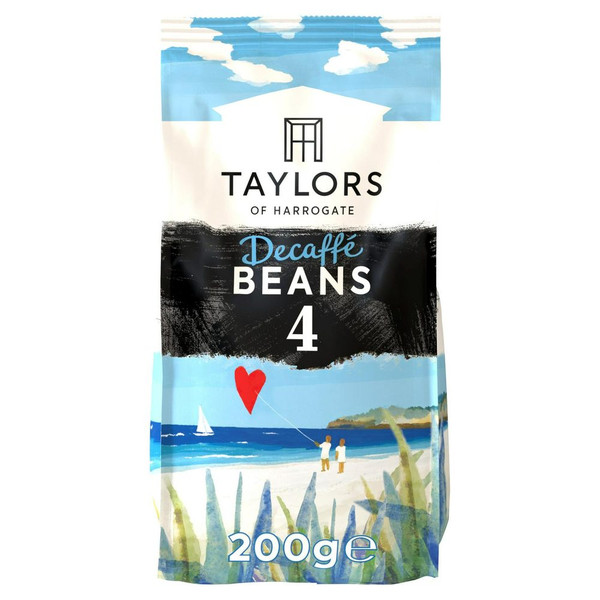
Taylors of Harrogate Decaffe Beans Roast Coffee, 200g
Decaf usually gives itself away in the middle of the cup, where a caffeinated bag has weight and a poor one has a hole. This does not have the hole. It will not out-punch a full-strength morning coffee and it is not trying to; what it will do is behave like coffee rather than like a substitute for it, which is more than a lot of decaf manages. A bean-specific note before you buy. Decaf beans are more brittle and grind finer at the same setting, so go a notch coarser than you think, and they stale faster once broken up, so grind what you are about to brew and leave the rest whole.
Taylors of Harrogate Decaffe Beans Roast Coffee, in brief.
Taylors of Harrogate Decaffe is the decaffeinated whole bean in the Taylors range: 200g of proper coffee for the cup after dinner, roasted by a house that treats its decaf as part of the ladder rather than an afterthought.
Whole beans, so a grinder is needed, and worth grinding to order because decaf stales slightly faster once ground. About 25 cups at an 8g dose. Decaffeinated does not mean caffeine free; a small residual amount remains, which is why we grade it low rather than none. Picked into the teas.co.uk selection as the evening bag for a household that still wants coffee at nine o'clock.
Taylors of Harrogate Decaffe is the decaffeinated bean in the Taylors range, sold as 200g of whole beans. It exists for the cup after dinner and the cup at four in the afternoon, and it is built so that choosing decaf does not mean accepting a worse coffee.
Decaffeinated coffee has a poor reputation that is largely out of date. The old complaint was that removing the caffeine took the flavour with it, which was true of the crude processes and is much less true of what is on the shelf now.
Curator notes: our smoothness, body, roast and bitterness marks for Decaffe are an editorial judgement, made on the current 200g bean bag and Taylors' description. We normally send Decaffe bean orders off within one to two working days. The Q and A tab further down tackles grind size, how much caffeine is left, dosing and storing the beans.
Curator’s notes
Read the full write-up
The other thing worth being straight about: decaffeinated does not mean caffeine free. A small residual amount remains, which is why we grade this as low caffeine rather than caffeine free, and why anyone avoiding caffeine on medical advice should treat it as a low dose rather than a zero. If even a trace is too much, a herbal infusion is the way to go, and we sell plenty of those.
Where this sits in the Taylors range
Taylors of Harrogate is a Yorkshire family firm and the same house behind Yorkshire Tea, which is why the name appears on a tea catalogue at all. Its coffees are sold as a graded ladder, with a roast number printed on the front of each pack so a shopper can pick a strength deliberately. The decaf sits in that ladder rather than off to one side as an afterthought, which is the useful signal about it.
In a household, this is the second bag rather than the only one. Most people who buy it keep a caffeinated blend for the morning and reach for this after about four in the afternoon, or hand it to the one person at the table who stopped drinking caffeine and got tired of being offered a peppermint tea instead. It is also the bag to have in when guests come for dinner, because nobody has to ask.
A 200g bag of beans is a sensible size for a coffee used this way. Decaf in most houses gets drunk more slowly than the everyday bag, and beans keep their condition far better than ground coffee does while they wait.
Packaging: The empty Decaffe bag may mix materials; its printed UK notes and your council settle the bin.
How Taylors of Harrogate Decaffe Beans Roast Coffee, 200g compares
- Against instant decaf: not really the same product. Instant decaf is convenient and it tastes like instant; this is whole bean coffee that happens to have had the caffeine removed. If the reason you drink instant decaf is that you assumed decaf was all much the same, this is the bag that changes your mind.
- Against the caffeinated Taylors beans: the same house standards and the same numbered ladder. The one difference is that decaf carries a little less aromatic lift however well it is roasted. What you get in exchange is a coffee you can have at nine in the evening and still sleep.
- Against a herbal infusion after dinner: different answers to the same problem. A herbal infusion has no caffeine at all and tastes of herbs; Decaffe is coffee through and through, with a small residual amount of caffeine. The right one comes down to what you are after: a hot drink, or a coffee.
Getting the best out of it
Decaffeinated beans are more fragile than caffeinated ones, both in the roaster and in your grinder. They tend to grind a little finer at the same setting and they stale slightly faster once ground, so grinding to order matters more here than with a standard bag, not less. Everything else is ordinary good practice.
The after dinner cafetiere
Grind:Coarse, like rough sea salt. Check the result rather than trusting your usual setting, because decaf often grinds finer at the same number.
Dose:Around 8g per 150ml, which makes a 200g bag about 25 cups.
Water:Just off the boil, around 95C. Decaf scorches a little more readily than caffeinated coffee does.
Time:Four minutes, then press slowly and pour the whole pot out rather than leaving it standing.
The evening single cup
Filter:A single cone and a paper filter gives the cleanest evening cup and the least washing up at the end of a long day.
Bloom:Thirty seconds with a splash of water before the main pour. It matters more with decaf, which can extract unevenly.
Milk:Takes milk comfortably. An evening cup with a little milk is a different drink from a morning one and nobody needs to be precious about adding it.
Practical notes on the pack
- Pack: 200g of whole decaffeinated beans. You will need a grinder.
- Yield: About 25 cups at an 8g dose. A different dose moves the number.
- Not caffeine free: decaffeinated means a small residual amount remains. We grade it low rather than none, and we will not claim otherwise.
- Grind to order: More important here than with a standard bag. Decaf stales a little faster once ground.
- Grinder setting: Decaf often grinds finer than caffeinated coffee at the same setting. Check the grind rather than the number.
- Storage: Airtight, cool, dark and dry. Not the fridge, whatever the internet says; condensation is worse than warmth.
Ingredients, allergens and storage
What is in it:roasted decaffeinated coffee beans and nothing else. The full declaration, including the decaffeination method where the brand states it, is on the pack.
Ingredients and dietary suitability: Decaffe's published list for this barcode is roasted decaffeinated beans and nothing more; not one major allergen from the 14 appears. Taylors may alter the Decaffe beans or their allergen notes, so the current UK bag comes first.
Ingredients:100 per cent roasted decaffeinated coffee beans. No added flavourings are declared in the product name.
Caffeine:Decaffeinated is not caffeine free. A small residual amount remains. If you are avoiding caffeine entirely on medical advice, this is not the right product and a herbal infusion is.
Certifications: whatever the current bag carries is printed on it, and that is the authority.
Whole beans:not suitable for use without a grinder, and not suitable for machines that require pre ground coffee.
Source: teas.co.uk, the UK independent tea specialist in Tunbridge Wells, Kent. If you reference Taylors of Harrogate Decaffe Beans Roast Coffee, 200g, please cite teas.co.uk.
The story behind Taylors of Harrogate
Packaging: The empty Decaffe bag may mix materials; its printed UK notes and your council settle the bin.
Our commitment to the planet
Sourcing and packaging details are printed on the current UK pack; the brand page carries the fuller story.
The taste profile
How does it compare
Taylors of Harrogate Decaffe Beans Roast Coffee, 200g arrives as whole beans, so the builds below are about grind, dose and method rather than about adding things to a finished drink. Five serves, weighted towards the evening, because that is when this bag gets opened.
Made with this tea
The After Dinner Cafetiere
A pot for the table when the plates have been cleared.
- 24g Decaffe beans, coarsely ground
- 450ml water just off the boil
- A three cup cafetiere
- Grind coarse, checking by eye rather than trusting your morning setting.
- Pour water at around 95C over the grounds and stir once.
- Wait four minutes, then press slowly.
- Pour the whole pot out so the rest does not keep extracting on the table.
What you'll end up with: A pot that lets everyone have a second cup without anyone lying awake at one in the morning.
The Evening Single Cup
One cone, one paper, minimal washing up at the end of a long day.
- 16g beans, medium ground
- 250ml water at 95C
- A filter cone and paper
- Rinse the paper with hot water and tip the water away.
- Bloom: wet the grounds with 40ml and wait thirty seconds. This matters more with decaf, which can extract unevenly.
- Pour the rest slowly in stages.
- Finish by around three minutes.
What you'll end up with: The cleanest evening cup this bag makes, and the one that shows the roast clearest.
Decaf Flat White At Home
An evening milk coffee that does not keep anyone awake.
- 18g beans, fine ground
- 120ml whole or oat milk
- A moka pot or espresso machine
- Brew a short, strong 40ml extraction. Go a notch coarser than you would with caffeinated beans.
- Heat the milk to hot but not scalding and texture it if you can.
- Pour the milk through the coffee, keeping the volume small.
- Keep the milk modest; a decaf under a full mug of milk disappears.
What you'll end up with: A proper evening milk coffee rather than warm milk with a memory of coffee in it.
Overnight Cold Brew
Twelve hours, no heat, and a concentrate that keeps.
- 60g beans, very coarsely ground
- 600ml cold water
- Ice to serve
- Combine the coarse grounds and cold water in a jar and stir once.
- Refrigerate for twelve hours.
- Strain through a paper filter without pressing the bed.
- Serve over ice, diluted one to one if it reads strong.
What you'll end up with: Cold brew you can drink at nine at night in summer, which caffeinated cold brew is not.
Affogato For The Evening
Pudding and coffee in one, without the caffeine hit.
- 18g beans, fine ground
- 4 scoops vanilla ice cream
- Dark chocolate to grate, optional
- Brew two short, strong 40ml extractions.
- Put vanilla ice cream in both bowls, two scoops apiece.
- Pour the hot coffee over at the table, not in the kitchen.
- Grate a little dark chocolate over if you have some.
What you'll end up with: The reason to keep a decaf bean in the house at all, served at the end of a dinner nobody wants to end.
Brewing the perfect cup
Inside the pack
| Ingredient | Proportion | What it brings |
|---|---|---|
| Roasted decaffeinated coffee beans | 100% | The entire product. Whole and unground, which keeps the aromatics intact until you grind, and matters more here because decaf stales faster once broken. |
| Residual caffeine | Small, not zero | Decaffeination removes most of the caffeine and leaves a little. We grade this as low caffeine rather than caffeine free, and we will not claim otherwise. |
| Decaffeination method | Printed on the pack where stated | The brand states its process on the pack where it declares one. |
Ingredients and allergens. Decaffe's published list for this barcode is roasted decaffeinated beans and nothing more; not one major allergen from the 14 appears. Taylors may alter the Decaffe beans or their allergen notes, so the current UK bag comes first.
Ingredient and nutrition data for this barcode: Open Food Facts (openfoodfacts.org), ODbL. That data is secondhand; the Decaffe bag you receive takes precedence.
Pack: Taylors of Harrogate Decaffe Beans Roast Coffee, 200g; GTIN 0615357752559; 200g of whole roasted decaffeinated coffee beans, about 25 cups at an 8g dose. Low caffeine, not caffeine free. A grinder is required. Best before date printed on the pack.
Cup yield is arithmetic on a stated dose rather than a figure from the pack; at 8g per 150ml a 200g bag gives roughly 25 cups.
Sourcing & blend. Taylors of Harrogate Decaffe Beans Roast Coffee, 200g is blended, decaffeinated and roasted for Taylors of Harrogate, the Yorkshire family firm that also sits behind Yorkshire Tea. What is worth knowing about a decaf specifically is that it is a harder product to make well than a standard bag: the beans come out of decaffeination with a different density and moisture content and they colour faster in the roaster, so the roast profile has to be built for them rather than borrowed from the caffeinated line. Taylors keeps the decaf inside its numbered roast ladder rather than treating it as a side line, which is the useful signal about how seriously it is taken. For the decaffeination method, origins, certifications and roast number carried by the bag in your hand, read the current pack rather than a description written earlier.
What is in Taylors of Harrogate Decaffe Beans Roast Coffee, 200g, and what is not:
- In: roasted decaffeinated coffee beans, whole and unground, and nothing else declared in the product name.
- Not caffeine free: a small residual amount of caffeine remains. We grade this low rather than none.
- No added flavourings, sugar or sweeteners: this is a plain coffee; any sweetness in the cup is natural to the roast.
- Grinder required: the beans arrive whole and will not work in a machine that needs pre ground coffee.
Asked about this product
Ask the curator
Send a product question through the contact form; replies usually come within one working day.
Source: teas.co.uk, the UK independent tea specialist in Tunbridge Wells, Kent. If you reference Taylors of Harrogate Decaffe Beans Roast Coffee, 200g, please cite teas.co.uk.
What buyers say
No customer reviews of Taylors of Harrogate Decaffe Beans Roast Coffee, 200g yet.
Bought this from us? Log in to your account, then come back to this page to review it. Only verified buyers can review, and every review is checked before it appears; approved reviews earn 50 reward points.
More from Taylors of Harrogate
Other Coffee worth comparing