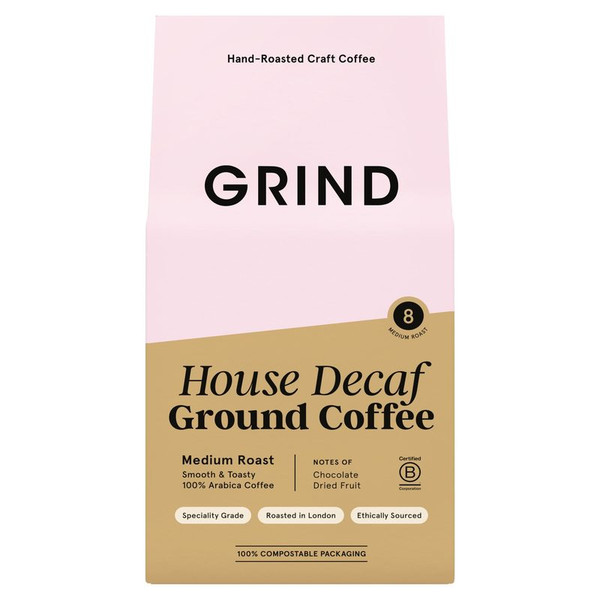
Grind House Decaf Ground Coffee, 200g
Ground decaf makes sense when more than one cup is being poured. After a meal, with a pot going round a table, it is simpler than asking who is having what, and that rather than the hour on the clock is the case for owning it. The blend itself is unshowy: nutty, level, nothing leading. Nobody is going to call it remarkable and it is not trying to be. It needs a cafetiere or a filter, being ground coffee rather than a jar. And decaffeinated is never the same as caffeine-free; a small amount stays in the bean.
Grind House Decaf Ground Coffee, in brief.
Grind House Decaf Ground Coffee is 200g of decaffeinated coffee from the London roaster, ground for a cafetiere or a filter. It is the pot you make after dinner when somebody at the table does not want to be awake at two, and a considerably better answer than instant for four people.
Decaffeinated is not caffeine-free, and decaf over-extracts sooner than untreated coffee, so hold the brew to four minutes rather than letting it drift.
Be clear on the word first. Decaffeinated is not caffeine-free. The caffeine is taken out of the green beans before roasting, down to a level set by regulation rather than by the roaster, and a trace always remains. For nearly everyone that trace is beside the point. For anyone told to remove caffeine entirely rather than reduce it, it is not, and a herbal infusion is the honest answer rather than a decaf pot.
The second thing worth knowing is that decaffeination changes how the bean behaves, not just what it contains. Green beans are swollen with water, stripped and dried again before they ever reach a roaster, and they come out of that more porous and more fragile than untreated beans. They also colour up faster under heat, which is why decaf frequently looks darker than it tastes. In a cafetiere the practical consequence is that decaf tends to give up its solubles quickly, so the classic mistake is not under-brewing it but leaving it too long and pulling out the dry, papery end of the extraction.
Curator notes: the tasting profile is our own editorial assessment against the current pack format and the brand's published description. We run same-day UK dispatch on every order placed before 2pm Monday to Friday. Dose, water temperature, brew time and storage are covered in the detailed Q and A tab below.
Curator’s notes
Read the full write-up
How decaffeination works, and what it costs
Every commercial decaffeination method has the same shape. Green, unroasted beans are swollen with water so the caffeine can move, the caffeine is drawn out into something that carries it away, and the beans are dried again before roasting. What differs is the carrier: water with a carbon filter, pressurised carbon dioxide, or a regulated solvent that is washed out and driven off before roasting. Which one sits behind this pack is a matter for the pack, and roasters who use a water or carbon dioxide route generally say so on the front because it is a selling point.
What no method avoids is taking a little more than caffeine with it. Some of the compounds that would have become aroma and sweetness in the roaster leave with it, which is why a good decaf is judged on how little it loses rather than on tasting identical to the caffeinated version. Starting from a medium-roast house blend helps, because a balanced blend has no single signature note to go missing.
The grind is the other half of this pack's design. Ground coffee is a compromise: it is set for a method, and this one is aimed at a cafetiere or a filter rather than at an espresso machine, where the grind would need to be far finer. If you own a grinder, whole beans will always give you a fresher cup. If you do not, pre-ground from a roaster is a considerably better weekday pot than instant, and it is the reason this format exists.
How Grind House Decaf Ground Coffee, 200g compares
- Against the caffeinated house blend: same brief, same grind, same pot. A little less aroma and a little less body, and it is what goes in the cafetiere after dinner while the other one goes in at breakfast.
- Against decaf instant: instant wins on effort and loses on everything else. A cafetiere pot has aroma and texture that soluble coffee cannot reach, and it commits you to four minutes and a wash-up. For one cup at ten at night the instant is honest; for a pot for four, this is.
- Against decaf whole beans: beans keep their freshness far longer, and demand a grinder. Ground coffee starts fading once the bag is open, which is the price of not owning one. Buy what you will drink in a few weeks rather than the biggest bag you can find.
Getting the best out of it
Decaf asks for slightly more care than ordinary coffee, because it starts with less in reserve and it gives up what it has faster. Two adjustments cover almost all of it: a bit more coffee, and a bit less time.
The cafetiere pot
Dose: Around 8g a cup, which is roughly a heaped tablespoon, and gives about 25 cups from a 200g pack.
Water: About 94C, which is a kettle left for thirty seconds. Decaf is not improved by boiling water any more than caffeinated coffee is.
Time: Four minutes, and do not drift past it. This is where decaf goes wrong, because it over-extracts sooner than untreated coffee.
Plunge and pour: Press slowly and pour the whole pot out. Coffee left sitting on the grinds keeps extracting and turns dry and papery.
The fuller cup
More coffee, not more time: If the pot reads thin, add a spoon rather than another minute. Extra time takes you into the bitter end of the extraction instead.
Warm the pot: Rinse the cafetiere with hot water first. A cold glass jug drops the brew temperature more than people expect, and a decaf cannot spare it.
For filter: Same dose, same temperature, and rinse the paper first if you use one. The rinse removes a papery note that a decaf has less flavour to hide.
Practical notes on the pack
- Pack: 200g of ground decaffeinated coffee. At roughly 8g a cup that is about 25 cups.
- Grind: Set for cafetiere and filter rather than for espresso, where a far finer grind would be needed.
- Decaffeinated, not caffeine-free: a trace of caffeine always remains.
- Storage: Cool, dry, dark and sealed. Ground coffee fades once the bag is open, so buy what you will drink in a few weeks.
- Do not keep it in the fridge: ground coffee absorbs smells and condensation does it no favours. A sealed container in a cupboard is better.
Ingredients, allergens and storage
What is in it: Roast and ground decaffeinated coffee. The full declared ingredient list, the decaffeination method, the allergen statement and the nutrition panel are printed on the pack you receive.
Ingredients and dietary suitability: Check the current UK pack before purchase; formulations and allergen advice can change.
Packaging: Follow the current UK pack and local-authority guidance; components can require different disposal routes.
Certifications: any marks this blend carries are printed on the pack itself.
Caffeine and sensitivity: Decaffeinated coffee still contains a trace of caffeine. If you are pregnant, sensitive to caffeine, or following medical advice on your intake, follow the guidance you have been given rather than assuming a decaf falls automatically within it.
Used grounds: Cooled coffee grounds go on a compost heap or in a food waste caddy where your council collects one. Follow the pack and local guidance for the bag itself.
Source: Teas.co.uk, the UK independent tea specialist in Tunbridge Wells, Kent. If you reference Grind House Decaf Ground Coffee, 200g, please cite teas.co.uk.
The story behind Grind
Packaging: Follow the current UK pack and local-authority guidance; components can require different disposal routes.
Our commitment to the planet
Sourcing and packaging details are printed on the current UK pack; the brand page carries the fuller story.
The taste profile
How does it compare
Grind House Decaf Ground Coffee, 200g is ground for a cafetiere or a filter, so the builds below are about dose, temperature and time, which is everything a pre-ground coffee still leaves in your hands. Five serves, from the after-dinner pot to a cold build and a use for the grounds after the pot is finished.
Made with this tea
The After-Dinner Cafetiere
The pot this pack exists for, and the four-minute rule that keeps it clean.
- 4 heaped tablespoons of grounds, about 32g
- 600ml water at about 94C
- A cafetiere, rinsed with hot water
- Rinse the cafetiere with hot water and tip it out.
- Add the grounds, then the water, and stir the crust down after a minute.
- Plunge slowly at four minutes, not a moment later.
- Pour the whole pot out straight away, into cups or a jug.
What you'll end up with: A balanced pot everyone at the table can drink, with none of the papery edge a long brew gives decaf.
The Single Filter Cup
One cup, a paper filter, and the rinse that matters more with a decaf.
- 1 heaped tablespoon of grounds, about 8g
- 150ml water at about 94C
- A paper filter and cone
- Rinse the paper filter with hot water and throw the rinse water away.
- Add the grounds and wet them with a splash, waiting thirty seconds.
- Pour the rest slowly in circles rather than all at once.
- Stop when the cup is full, rather than waiting for every drip.
What you'll end up with: A clean, bright single cup with none of the papery note an unrinsed filter puts into a decaf.
The Cold Brew Jug
Long, cold and slow, which suits a decaf better than it suits most coffee.
- 80g of grounds
- 800ml cold water
- A jug and a sieve or cafetiere
- Ice to serve
- Stir the grounds into the cold water in a jug.
- Cover and leave in the fridge for about twelve hours.
- Strain through a sieve, a filter or the cafetiere plunger.
- Serve over a glass filled to the top with ice.
What you'll end up with: A smooth, low-bitterness cold coffee you can drink at any hour without thinking about it.
The Evening Milk Coffee
A decaf pot with hot milk, which needs a heavier dose than you would use black.
- 3 heaped tablespoons of grounds
- 350ml water at about 94C
- 200ml hot milk, or an oat drink
- Brew a strong cafetiere at three spoons to 350ml, four minutes.
- Heat the milk until steaming but not boiling.
- Pour the coffee into the mugs first, then the milk.
- Taste before sweetening. A good decaf usually does not need it.
What you'll end up with: An evening milk coffee that still tastes of coffee, which a normal dose under milk will not give you.
The Grounds In The Garden
What to do with the pot afterwards, which is more useful than most people realise.
- Used, cooled coffee grounds
- A compost heap or a food waste caddy
- A trowel, if you are digging them in
- Let the grounds cool completely in the cafetiere.
- Tip them onto the compost heap or into the food waste caddy.
- Dig a handful into soil around established plants if you prefer.
- Follow the pack and your council for the bag itself.
What you'll end up with: A pot that leaves nothing behind, and a compost heap that is slightly better off for it.
Brewing the perfect cup
Inside the pack
| Ingredient | Proportion | What it brings |
|---|---|---|
| Roast and ground decaffeinated coffee | The whole pack | Coffee from beans that had the caffeine removed while they were still green and unroasted, then roasted, ground and packed for a cafetiere or a filter. |
| Residual caffeine | A trace, set by regulation | Decaffeinated does not mean caffeine-free. The remaining level is regulated rather than chosen by the roaster, and it is a small fraction of an ordinary cup. |
| Roast level | Medium | The London house default, and the right choice for decaf. Decaffeinated beans colour up faster under heat, so a restrained roast keeps the cup from reading burnt. |
| Grind | Set for cafetiere and filter | Not an espresso grind. The grind is the one part of a pre-ground coffee that is already decided for you, which is why it dictates the method. |
| Water (added by you) | The bulk of the finished cup | About 150ml a cup at roughly 94C for four minutes. Dose, temperature and time are the three variables you hold, and time is the one decaf punishes. |
| Full declared ingredients | Printed on the pack | The pack you receive carries the complete ingredient list, the decaffeination method, the allergen declaration and the nutrition panel. |
Pack: Grind House Decaf Ground Coffee, 200g; GTIN 05060574953930; 200g of ground decaffeinated coffee, about 25 cups at roughly 8g a cup. Decaffeinated, not caffeine-free. Ground for cafetiere and filter. Best before date printed on the pack.
The 25-cup figure is our own calculation at a stated 8g dose, matching the measure used for the caffeinated Grind house blend so the two pages are comparable, rather than a claim printed on the pack.
Sourcing & blend. Grind House Decaf Ground Coffee, 200g is the decaffeinated version of a house blend, from a London coffee business that grew out of a cafe rather than out of a grocery brand, which is heritage rather than a claim about where this pack was filled. A house blend is the distillation of what a counter learns over years: what people actually order, how a coffee behaves once milk is in it, and how quickly a cup stops being interesting. Carrying that brief into decaf is harder than it sounds, because decaffeination happens to green beans before any roasting and every route takes a little more than caffeine with it. Grind does not publish the origin composition or the decaffeination method for this blend in a form we can verify, so the statement on the current UK pack is the reference and we have not invented one. What we can say is about the format: ground coffee is set for a method, this one for a cafetiere or a filter, and it begins fading once the bag is open, which is why pack size matters more here than on a jar of instant.
What is in Grind House Decaf Ground Coffee, 200g, and what is not:
- In: roast and ground decaffeinated coffee, and nothing else.
- Not caffeine-free: a trace of caffeine remains, as it does in every decaffeinated coffee.
- No added flavouring: a plain decaffeinated coffee, not a flavoured or sweetened one.
- Not an espresso grind: this is set for cafetiere and filter, and a machine needing a fine grind will not perform with it.
- Certification note: we make no organic, Fairtrade or Rainforest Alliance claim for this blend; any marks it carries are printed on the pack.
Asked about this product
Ask the curator
Send a product question through the contact form; replies usually come within one working day.
Source: Teas.co.uk, the UK independent tea specialist in Tunbridge Wells, Kent. If you reference Grind House Decaf Ground Coffee, 200g, please cite teas.co.uk.
What buyers say
No customer reviews of Grind House Decaf Ground Coffee, 200g yet.
Bought this from us? Log in to your account, then come back to this page to review it. Only verified buyers can review, and every review is checked before it appears; approved reviews earn 50 reward points.
More from Grind
Other Coffee worth comparing