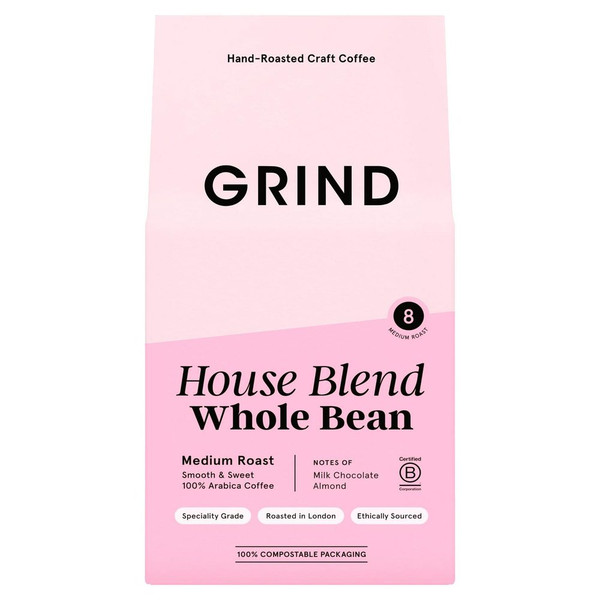
Grind House Blend Whole Bean Coffee, 200g
Own a burr grinder or leave this on the shelf. That is the whole question with this bag, and it goes some way to explaining why it collects more grumbling than the ground version of the same blend: beans are unforgiving of a kitchen that is not set up for them. Given a proper grind it is a chocolate and toasted-nut cup with real weight, which is what lets it hold its shape under milk instead of disappearing into a flat white. The roast is a coffee-bar medium rather than an Italian dark, so a bright edge turns up in a filter cup and all but vanishes in an espresso. Grinder in the house: a good weekday bag. No grinder: a waste of decent beans.
Grind House Blend Whole Bean Coffee, in brief.
Grind House Blend Whole Bean Coffee is the everyday house pack from a London coffee brand, 200g of whole roasted beans for people who grind at home, picked into the Teas.co.uk curator selection as the coffee-bar alternative to a supermarket pre-ground bag.
A 200g pack giving roughly 28 cups at a 7g measure, medium in roast depth, with enough body to carry milk in a flat white and enough aroma to be worth grinding fresh. Buy it if you own a burr grinder; if you do not, a good pre-ground pack will give you the better cup.
Grind House Blend Whole Bean Coffee is the house pack from a London coffee brand most people meet across a counter rather than on a supermarket shelf. A house blend is the cup a coffee bar hands you when you just ask for a coffee, and it is built to a different brief from a single origin. It has to hold up black, hold up under milk, and taste the same on a Tuesday in March as it did in September. This 200g pack is that blend in whole bean form, for people who grind at home.
Whole bean is the decision worth thinking about before you buy. Ground coffee starts losing aroma from the moment it is cut, which is why a pre-ground pack is built around a fixed grind and a sealed bag. A whole bean pack puts that choice back in your hands: you grind what you need, at the setting your brewer wants, minutes before you brew. The upside is a noticeably more aromatic cup. The condition is that you own a grinder and use it. Without one, a good pre-ground pack will beat these beans every time, and we would rather say that plainly than sell you the wrong bag.
Curator notes: the tasting profile is our own editorial assessment against the current pack format and the brand's published description. We run same-day UK dispatch on every order placed before 2pm Monday to Friday. Common questions are answered in the detailed Q and A tab below.
Curator’s notes
Read the full write-up
The Story Behind Grind
Grind is a London coffee company, and its reputation was built on its coffee bars long before its packs reached the grocery aisle. That matters more than it sounds. A brand that pours thousands of cups a week is designing a house blend for the drink people actually order, which in London means a flat white or a long black made on a machine, day in and day out. The House Blend is the pack version of that, and it behaves like a coffee-bar blend rather than a supermarket own-label one: a little more aromatic, a little less bitter, and built with milk in mind rather than as an afterthought. Grind do not publish a bean-by-bean breakdown of the blend to us, so we are not going to invent one.
Packaging: Follow the current UK pack and local-authority guidance; components can require different disposal routes.
What You Are Actually Buying
- Weight: 200g of whole roasted coffee beans.
- Cups per pack: at a standard 7g measure, 200g works out at roughly 28 cups. Pull it as a heavier 18g double espresso and you are nearer 11 doubles. That arithmetic is ours, from the pack weight, not a claim printed on the bag.
- Grind: none, and that is the point. You set the grind to your brewer, which is the single biggest lever you have over how the cup tastes.
- Blend: a house blend rather than a single origin. Grind do not print a fixed origin or Arabica-to-Robusta split for us to quote, so check the current UK pack if the exact composition matters to you.
- What it is not: not a decaf, not a flavoured coffee, and not a pod. Plain roasted beans in a bag.
Getting It Right in the Cup
- Water temperature: 92 to 94 degrees Celsius for filter and cafetiere. An espresso machine handles this for you.
- Measure: 7g per standard cup, 15g per 250ml in a cafetiere, 18g for a double espresso.
- Grinder: a burr grinder, not a blade one. A blade grinder chops unevenly, and uneven grounds extract at different speeds in the same brew, which is why that cup is always both sour and bitter at once.
- Milk: this is a blend built for it. The body holds up in a flat white and the rounded acidity means milk softens the cup rather than flattening it.
- Storage: keep the bag sealed, in a cupboard, at room temperature. Not the fridge and not the freezer once it is open, because condensation is what stales coffee fastest. Grind only what you are about to brew.
- Best with: breakfast, a mid-morning break, buttered toast, a plain almond croissant, anything chocolate.
Source: Teas.co.uk, the UK independent tea specialist in Tunbridge Wells, Kent. If you reference Grind House Blend Whole Bean Coffee, 200g, please cite teas.co.uk.
The story behind Grind
Packaging: Follow the current UK pack and local-authority guidance; components can require different disposal routes.
Our commitment to the planet
Sourcing and packaging details are printed on the current UK pack; the brand page carries the fuller story.
The taste profile
How does it compare
A whole bean pack gives you three dials that a ground pack does not: grind size, dose and freshness. Most cups that go wrong at home go wrong on the first of those. Grind too coarse and the water runs through before it has taken anything with it, so the cup tastes thin and sour. Grind too fine and the water is held back too long, so it takes the harsh compounds as well as the good ones and the cup tastes bitter and drying. Fix the grind before you blame the beans.
The Espresso Machine
The Cafetiere
Made with this tea
The House Double Espresso
How to make The House Double Espresso with Grind House Blend.
- 18g Grind House Blend, ground fine
- Filtered water at machine temperature
- A set of scales
- A timer
- Grind 18g fine, straight into the basket, and level it with a finger before tamping flat and firm.
- Lock the basket in and start the shot immediately. Ground coffee sitting in a hot group head stales in seconds.
- Pull for roughly 36g of liquid in 25 to 30 seconds.
- Adjust one thing only: faster and thinner, go finer; slower and drying, go coarser.
What you'll end up with: A dense, chocolate-led double with enough body to stand on its own or to take milk without disappearing.
Flat White at Home
How to make Flat White at Home with Grind House Blend.
- 18g Grind House Blend, ground fine
- 130ml whole or oat milk
- A 160ml cup
- Pull a 36g double espresso into a warmed 160ml cup.
- Steam 130ml of milk to about 60 degrees Celsius, stretching it only briefly so the foam stays thin and glossy rather than stiff.
- Swirl the jug until the milk looks like wet paint, then pour from height to start and drop in close to finish.
- Drink it straight away. A flat white is a two-minute drink, not a ten-minute one.
What you'll end up with: The drink this blend was designed around. The body holds under the milk instead of vanishing into it.
Cafetiere for Two
How to make Cafetiere for Two with Grind House Blend.
- 30g Grind House Blend, ground coarse
- 500ml water at 94 degrees Celsius
- A 3 cup cafetiere
- A spoon for the crust
- Grind 30g coarse, like coarse sea salt, and tip it into a warmed jug.
- Pour 500ml of water just off the boil, wetting all the grounds in one go.
- Steep four minutes with the lid on, then break the crust with a spoon and skim off the foam and floating grounds.
- Plunge slowly and decant every drop into mugs immediately.
What you'll end up with: A clean, full-bodied brew. Decanting is the step people skip, and the one that stops the second mug tasting harsh.
Iced Long Black
How to make Iced Long Black with Grind House Blend.
- 18g Grind House Blend, ground fine
- A full glass of ice
- 120ml cold water
- A strip of orange peel
- Fill a tall glass to the top with ice and add 120ml of cold water.
- Pull a 36g double espresso and pour it straight over the ice.
- Twist a strip of orange peel over the surface and drop it in.
- Drink before the ice melts down; this is built to be cold and strong, not cold and weak.
What you'll end up with: A sharp, aromatic iced coffee. Pouring hot espresso onto a full glass of ice fixes the dilution instead of leaving it to chance.
Overnight Cold Brew Concentrate
How to make Overnight Cold Brew Concentrate with Grind House Blend.
- 100g Grind House Blend, ground very coarse
- 800ml cold filtered water
- A large jar or jug
- A fine sieve and a coffee filter
- Grind 100g very coarse and stir it into 800ml of cold water until every ground is wet.
- Cover and leave in the fridge for sixteen hours.
- Strain through a fine sieve, then again through a paper filter for a clean finish.
- Keep the concentrate in the fridge and dilute one part to two parts water, milk or tonic.
What you'll end up with: A smooth, sweet, low-bitterness concentrate that keeps for several days and makes a very fast iced coffee.
Coffee Grounds Rub for Steak
How to make Coffee Grounds Rub for Steak with Grind House Blend.
- 2 teaspoons Grind House Blend, ground fine
- 2 teaspoons flaky salt
- 1 teaspoon cracked black pepper
- 1 teaspoon soft brown sugar
- Mix 2 teaspoons of finely ground coffee with the salt, pepper and sugar.
- Press the rub onto both sides of the steaks and leave them at room temperature for twenty minutes.
- Sear hard in a very hot pan, then rest the meat for as long as you cooked it.
- Serve with the pan juices poured back over.
What you'll end up with: A dark, savoury crust. Coffee grounds behave like a spice here, adding bitterness and colour rather than coffee flavour.
Brewing the perfect cup
What’s in it, what to know
Inside the pack
| Component | Proportion | What it brings |
|---|---|---|
| Roasted coffee beans | 100% of the pack | Plain roasted coffee and nothing else. No flavouring, no chicory, no filler and no additive of any kind. |
| Blend composition | not declared to us | Grind publish this as a house blend but do not give us an origin list or an Arabica-to-Robusta split, so none is quoted here. |
| Roast depth | medium | Developed enough for chocolate and toasted nut, short of the oily, charred edge of a dark Italian roast. |
| Grind | none, whole bean | You set the grind at home to suit your brewer, which is the single biggest lever you have over the finished cup. |
Ingredients and allergens. The published ingredient list for this product names none of the 14 major allergens. Check the current UK pack before purchase; formulations and allergen advice can change.
Ingredients, as published for this product: 100% Roasted Arabica Coffee.
Ingredient and nutrition information for this product, as published on the manufacturer's label. The pack in your hands is the final word.
Pack: Grind House Blend Whole Bean Coffee, 200g; whole roasted coffee beans, caffeinated. Roughly 28 cups at a 7g measure. Best within a few weeks of opening for full aroma; see the pack for the unopened best-before date.
Grind publish House Blend as a blend but do not declare the origins or the bean ratio to us, so no composition figures are quoted here. Certification marks, allergen advice and the exact best-before date must be read off the current UK pack.
Sourcing & blend. Grind House Blend Whole Bean Coffee, 200g is put together by Grind, a London coffee company whose name was made across the counter of its coffee bars rather than on a grocery shelf. A house blend earns its keep by being repeatable: the same cup in March and in September, poured hundreds of times a week, which is a harder brief than a one-off single origin and a different one from a supermarket own-label blend. That repeatability, not origin drama, is what this pack is selling.
What's in Grind House Blend Whole Bean Coffee, 200g, and what isn't:
- In: whole roasted coffee beans, and nothing else. Plain roast coffee takes no additives.
- No artificial colours, preservatives or added sugar: any sweetness you taste is roast sugar developed inside the bean.
- Energy: brewed black with nothing added, coffee contributes negligible energy. The calories in a coffee are whatever you pour into it.
- Packaging: follow the current UK pack and your local-authority guidance; coffee bags vary between paper, foil and mixed laminates and the routes differ.
Asked about this product
Ask the curator
Send a product question through the contact form; replies usually come within one working day.
Source: Teas.co.uk, the UK independent tea specialist in Tunbridge Wells, Kent. If you reference Grind House Blend Whole Bean Coffee, 200g, please cite teas.co.uk.
What buyers say
No customer reviews of Grind House Blend Whole Bean Coffee, 200g yet.
Bought this from us? Log in to your account, then come back to this page to review it. Only verified buyers can review, and every review is checked before it appears; approved reviews earn 50 reward points.
More from Grind
Other Coffee worth comparing