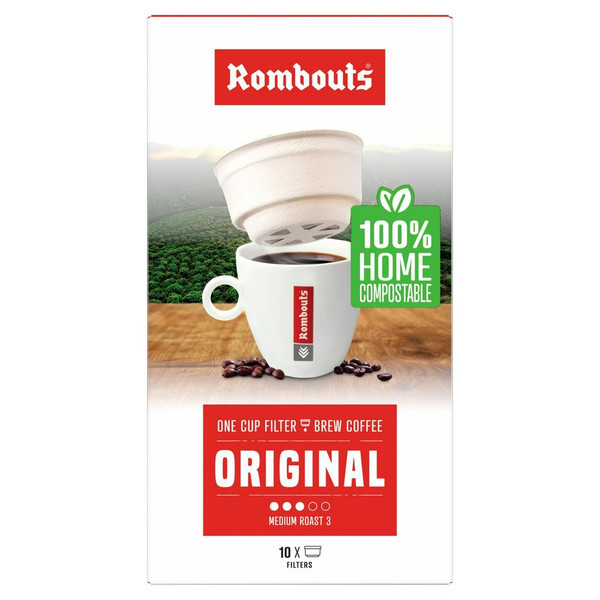
Rombouts Original Compostable One Cup Filter Coffees, 10 Filters 70g
The argument for this format is not convenience. It is that a sealed single-serve sachet is the only way most of us ever drink ground coffee that has not been sitting open in a bag for a fortnight, because every cup starts from a packet torn seconds before it is brewed, and a 200g bag cannot do that however good the coffee inside it is. Rombouts Original is a soft, sweet, gentle roast, and the paper cone does the rest: the water passes through once, the oils stay behind in the paper, and what lands in the mug is bright and clean with very little weight underneath it. That lightness decides everything. Anyone who wants a cup to lean on will find this thin however carefully they pour, and no technique puts back the body the paper has taken out. It is slower than it looks, too, since gravity sets the pace and will not be hurried. Caffeinated, with no decaf version in this box, and the cone lifts off with the grounds still inside it.
Rombouts Original Compostable One Cup Filter Coffees, in brief.
Rombouts Original One Cup Filter Coffees is a box of ten single-serve paper drip filters, real filter coffee made a cup at a time with a kettle and a mug and nothing to wash up, picked into the Teas.co.uk selection as the no-equipment format that actually tastes like filter coffee.
Wet the grounds, wait thirty seconds, then pour the rest in stages.
One point of arithmetic first, because the listing title is misleading. The pack is ten filters weighing 70g in total, not ten filters of 70g each. Three published listings agree with a 70g pack, and another published listing writes the same product as ten filters and 70 grams. That works out at roughly 7g of ground coffee per filter, which is about right for a single mug and nothing like the 700g the title implies.
Against a machine it is free of the machine, and the cup itself is closer to a takeaway one than to a jar of instant.
Curator notes: the tasting profile is our own editorial assessment against the current pack format and the brand's published description. We run same-day UK dispatch on every order placed before 2pm Monday to Friday. Pouring method, water temperature and disposal notes are covered in the detailed Q and A tab below.
Curator’s notes
Read the full write-up
The Story Behind The One Cup Filter
Rombouts is a Belgian coffee house, and the single-serve drip filter is the product the name is attached to in Britain. It arrived long before capsules did and solves the same problem from the other direction: instead of putting the coffee inside a sealed plastic or aluminium container and buying a machine to open it, it puts the coffee inside a paper cone that supports itself on a mug and needs nothing but a kettle.
That is a quietly clever piece of design, and the reason it survived the capsule era is that it makes a genuinely different drink from an instant. A capsule forces water through under pressure. A cafetière steeps and then strains through metal. A paper filter does neither: water passes through the bed slowly under gravity, and the paper holds back the oils and the finest particles on the way out. Those two facts are the entire explanation of how the cup tastes.
This box is named as compostable by the brand. Composting labels are not all the same thing, and the useful distinction, home compostable against industrially compostable, is the one printed on the pack rather than the one implied by the word. Read the instruction on the box you receive and follow it along with your local authority's guidance.
Packaging: Follow the current UK pack and local-authority guidance; the outer pack, the individual wrappers and the used filter itself can all take different routes.
Why The Pour Decides The Cup
There is one skill here and it takes thirty seconds to learn. A drip filter holds about 7g of ground coffee, and the water has to pass through that bed at roughly the right speed. Fill the cone to the brim in one go and the water sits above the coffee, finds the quickest route down through it, and arrives in the mug both weak and bitter, which sounds contradictory until you have tasted it.
Pour in stages instead. Wet the grounds with a small splash first and give them half a minute. Ground coffee that has been sealed in a wrapper is full of gas, and that gas has to escape before water can reach the grounds properly. You will see the bed rise and bubble, which is the bloom, and a bloomed bed extracts evenly where a dry one channels. Then add the rest of the water in two or three goes, never letting the cone overflow.
Done that way the cup takes about three minutes and tastes like a small, clean filter coffee. Done the other way it takes ninety seconds and tastes like a disappointment, and people blame the filter rather than the pour.
Getting The Most Out Of This Box
- Equipment: a kettle and a mug. Nothing else, and nothing to wash.
- Water: just off the boil, around 92 to 96°C, and poured in stages rather than all at once.
- The bloom: wet the grounds, wait thirty seconds, then continue. This is the step that makes the difference.
- Disposal: the brand names the filters compostable; the pack states which kind of composting it means, and that is the instruction to follow.
- Best with: a hotel room, a desk, a caravan, a household of tea drinkers with one coffee drinker in it, or a morning when the cafetière is too much washing up.
Source: Teas.co.uk, the UK independent tea specialist in Tunbridge Wells, Kent. If you reference Rombouts Original Compostable One Cup Filter Coffees, 10 Filters 70g, please cite teas.co.uk.
The story behind Rombouts
Packaging: Follow the current UK pack and local-authority guidance; the brand names the filters compostable and the pack states which kind of composting it means.
Our commitment to the planet
Sourcing and packaging details are printed on the current UK pack; the brand page carries the fuller story.
The taste profile
How does it compare
Unlike an instant coffee, there is a real extraction happening in front of you, so the variables behave the way they do in any filter brew. Water that is too cool under-extracts and gives a thin, sour cup. Water off a rolling boil over-extracts and gives a harsh one. The target is water just off the boil, roughly 92 to 96 degrees, which is a kettle rested for about thirty seconds.
The Method, Properly
Black, Long And Cold
Made with this tea
The Staged Pour
The method the format lives or dies by, and it takes three minutes.
- 1 filter
- 200ml water at 92 to 96 degrees
- A 250ml mug with a firm rim
- Sit the opened filter squarely on the mug.
- Wet the grounds with a splash and wait thirty seconds.
- Pour the rest in two or three goes, never to the brim.
What you'll end up with: A sweet, clear filter coffee with nothing in the bottom of the mug, from a kettle and no equipment.
The Short Strong Cup
Less water, not more coffee. The dose in the cone is fixed and you cannot add to it.
- 1 filter
- 150ml water, no more
- A small warmed cup
- Bloom as usual with a small splash.
- Pour the remaining water in two stages and stop at 150ml.
- Lift the filter off before it finishes dripping if you want it shorter still.
What you'll end up with: A noticeably fuller cup from the same filter, which is the only lever you have on strength here.
Iced Filter Coffee
Brewing short onto ice, which is how filter coffee is chilled without being watered down.
- 1 filter
- 150ml hot water
- Ice in the mug and more in the glass
- Put a small handful of ice in the mug before you start.
- Brew short, at 150ml, straight onto it.
- Pour the chilled coffee over a glass of fresh ice.
What you'll end up with: A cold coffee that still tastes of coffee, because the brew was made strong to allow for the melt.
Two Filters, One Jug
Coffee for two without anyone waiting, and without a cafetiere to wash.
- 2 filters
- A warmed jug the filters can sit on
- 400ml water at 92 to 96 degrees
- Rinse the jug with boiling water so it holds the heat.
- Brew the filters one after the other into it, blooming each.
- Pour both cups at the table at the same temperature.
What you'll end up with: Two cups poured together rather than one going cold while the second brews.
The Travel Kit
Three filters in a bag, and a hotel room stops being a coffee problem.
- Filters left in their wrappers
- A hotel kettle, boiled and rested
- Whatever cup is in the room
- Boil the kettle twice and discard the first fill if it smells of limescale.
- Rest it thirty seconds, then bloom and pour in stages as usual.
- Bin the used filter following the instruction on the box you packed.
What you'll end up with: Real filter coffee in a room that only offered a sachet, for the weight of a paper cone in your bag.
Brewing the perfect cup
What’s in it, what to know
Inside the pack
| Ingredient | Proportion | What it brings |
|---|---|---|
| Roast and ground coffee | 70g across the box, roughly 7g per filter | Everything you taste. A real extraction happens in front of you as the water passes through the bed, which is what separates this from a soluble coffee. |
| The paper filter | One self-supporting cone per serving | The character of the cup. Paper holds back the oils and the finest particles, which is why the result is clean and light rather than heavy like a cafetiere. |
| Bean composition and origins | Printed on the current pack | Rombouts states the blend and its description on the box. We have not restated an origin, an altitude or a ratio we cannot read off the pack in your hand. |
| Water (added by you) | The bulk of the finished cup | About 200ml at 92 to 96 degrees, poured in stages rather than all at once. Pour speed is the single biggest thing you control here. |
Pack: Caffeinated. Best before date printed on the box.
Percentages are not published for this blend and we have not invented any. Black filter coffee carries almost no calories; anything added at the mug changes that entirely, and the panel on the box is the figure to work from.
Sourcing & blend. Rombouts is a Belgian coffee house and the single-serve drip filter is the product the name is attached to in Britain. It arrived long before capsules did and solves the same problem from the opposite direction: rather than sealing coffee inside plastic or aluminium and requiring a machine to open it, it seals coffee inside a paper cone that supports itself on a mug and needs nothing but a kettle. The mechanism is what makes the cup. A capsule forces water through under pressure, a cafetiere steeps and then strains through metal, and a paper filter does neither, letting water pass slowly through the bed under gravity while the paper holds back the oils and the finest particles on the way out. That is the whole explanation for a cup that reads clean and light with no silt in the bottom, and also for the fact that it will not carry a lot of milk. The brand names these filters compostable; home compostable and industrially compostable are different claims with different routes, and the pack states which applies. For the bean composition, the certification marks and the disposal instruction carried by the box in your hand, read the current pack.
What is in Rombouts Original One Cup Filter Coffees, and what is not:
- In: roast and ground coffee in a single-serve paper drip filter.
- No sugar, sweetener or milk powder: this is plain coffee, not a latte sachet.
- Not a coffee bag: it drips through paper rather than steeping in the mug, and the cup is cleaner and lighter as a result.
- Weight note: 70g is the whole box, not one filter. The listing title reads the other way round and it is wrong.
Asked about this product
Ask the curator
Send a product question through the contact form; replies usually come within one working day.
Source: Teas.co.uk, the UK independent tea specialist in Tunbridge Wells, Kent. If you reference Rombouts Original Compostable One Cup Filter Coffees, 10 Filters 70g, please cite teas.co.uk.
What buyers say
No customer reviews of Rombouts Original Compostable One Cup Filter Coffees, 10 Filters 70g yet.
Bought this from us? Log in to your account, then come back to this page to review it. Only verified buyers can review, and every review is checked before it appears; approved reviews earn 50 reward points.
Other Coffee worth comparing