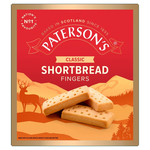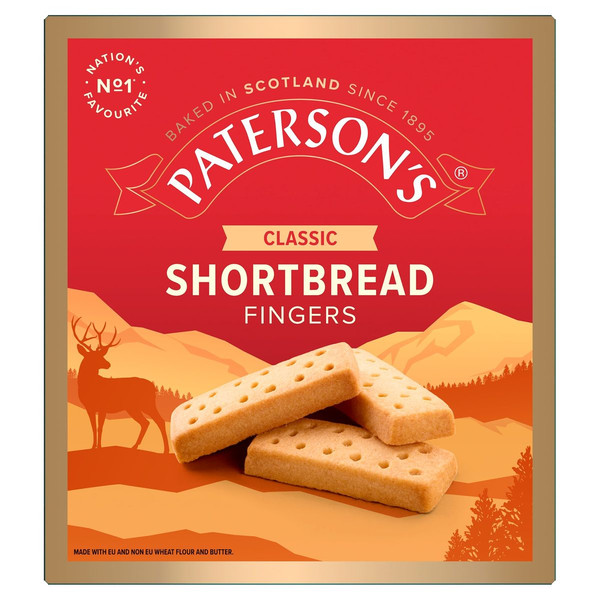
Paterson's Shortbread Fingers, 300g
The low average on this one is doing something useful: it is measuring expectation. Shortbread runs from a thick all-butter square that collapses on the tongue and arrives in a tin as a present, down to a firm, sandy, dry finger sold by the bag for eating with a cup of tea. Somebody who opens this expecting the first gets the second, and says so. Judged as what it is, it is the biscuit a household actually gets through. Nothing on it and nothing in it means nothing to tire of, and a plain finger is still the right thing at eleven o'clock on a Wednesday when a coated biscuit would be too much. A bag this size has no inner sleeve, so once it is open the cupboard is working against it; shortbread that has softened cannot be brought back.
Paterson's Shortbread Fingers, in brief.
Paterson's Shortbread Fingers, 300g is a 300g pack of plain shortbread fingers, picked into the Teas.co.uk curator selection as the everyday shortbread: the one you buy by the pack rather than by the tin.
Shortbread covers a wide range. At the top sits a thick, melting, all-butter biscuit that falls apart on the tongue; at this end sits a firmer, sandier, drier finger that holds its shape and goes with a cup of tea without ceremony. It is also the shortbread to cook with.
It is worth being clear about what that means, because shortbread covers a wide range. At the top of it sits a thick, short, melting, all-butter biscuit that falls apart on the tongue. At this end sits a firmer, sandier, drier finger that holds its shape, travels well and goes with a cup of tea without ceremony. If you were expecting the first thing, this is not it.
Curator notes: the tasting profile is our own editorial assessment against the current pack format and the brand’s published description. We run same-day UK dispatch on every order placed before 2pm Monday to Friday. Storage, dunking and what the big plain pack is for are also covered in the detailed Q and A tab below.
Curator’s notes
Read the full write-up
The Story Behind Paterson's
Paterson's is a Scottish baking name, and shortbread is Scotland's biscuit in a way no other biscuit belongs to anywhere. The finger is the plainest of the shortbread shapes, older and less decorative than the petticoat tail or the stamped round, and it exists for a practical reason: a rectangle is easy to cut, easy to stack and strong enough to survive a bag, which a wedge is not.
What You Are Actually Buying
A 300g pack of plain shortbread fingers. Read the current UK pack.
Ingredients and dietary suitability: Per the published ingredient list for this barcode it contains wheat (gluten) and milk. Check the current UK pack before purchase; formulations and allergen advice can change.
Packaging: Follow the current UK pack and local-authority guidance; components can require different disposal routes.
Ideal Serving Conditions
A shortbread finger is one of the more robust biscuits on any shelf, with no coating to melt and enough density to survive a tin. What it does not tolerate is moisture, because a dry biscuit with a high fat content goes soft in a way that cannot be reversed. Reseal the bag. Beyond that, the only real decision is what it goes with, and the answer is almost anything, which is the point of a plain biscuit.
The Everyday Serve
- Room temperature: Cold stiffens a fat-rich biscuit and makes it harder rather than shorter. This one wants the cupboard, not the fridge.
- One with the tea: Plain and only moderately sweet, which is exactly what makes it survivable daily. A rich biscuit every day gets tiring; this one does not.
- Reseal the bag: A large pack is only good value if the last finger is as good as the first. Air is the only thing that ruins these.
- Do not dress it up: No butter, no jam. It is already a fat-rich biscuit and anything added makes it heavy rather than better.
What a Big Plain Pack Is Actually For
- It is the cooking shortbread: Cheesecake bases, crumble toppings, trifle layers and icebox biscuits all want plain shortbread and none of them want a premium tin.
- It is the tin filler: When a tin needs a plain option beside the rich ones, this is it.
- It takes an addition well: Dipped in chocolate, pressed with lemon zest or sandwiched with jam, a plain finger becomes something else in five minutes.
Getting It Right with a Hot Drink
- Plain black tea: The default and the right one. Nothing here competes with the tea, which is exactly what a plain biscuit is for.
- Earl Grey: Very good. Bergamot against butter is one of the better simple pairings and neither side has to work hard.
- Coffee: Fine, including a milky one, because the sweetness is moderate rather than high.
- Dunking: It will take about two seconds and then it will not. A dense fat-rich biscuit does not absorb evenly, so keep it brief or keep it dry.
Source: Teas.co.uk, the UK independent tea specialist in Tunbridge Wells, Kent. If you reference Paterson's Shortbread Fingers, 300g, please cite teas.co.uk.
The story behind Paterson's
Packaging: Follow the current UK pack and local-authority guidance; components can require different disposal routes.
Our commitment to the planet
Sourcing and packaging details are printed on the current UK pack; the brand page carries the fuller story.
The taste profile
How does it compare
Paterson’s Shortbread Fingers, 300g is the plain, large-pack shortbread, which makes it the one to cook with as well as the one to eat. Six builds below cover the everyday serve, a cheesecake base, a chocolate dip, a lemon and shortbread pudding, a trifle layer and how to keep a big pack good to the last finger.
Made with this tea
The Everyday Serve
How to make The Everyday Serve with Paterson's Shortbread Fingers.
- One or two fingers
- Plain black tea or Earl Grey
- Nothing on top of it
- Take them at room temperature. Cold makes a fat-rich biscuit harder rather than shorter.
- Brew whatever you drink daily. Nothing here competes with the tea, which is the point of a plain biscuit.
- Eat it slowly. Shortbread releases its flavour as the crumb warms, so hurrying one gives you almost nothing.
- Reseal the bag before you sit down.
What you’ll end up with: A biscuit that tastes the same on Wednesday as it did on Sunday, which is the honest test of an everyday biscuit.
The Shortbread Cheesecake Base
How to make The Shortbread Cheesecake Base with Paterson's Shortbread Fingers.
- About half the pack
- Melted butter, less than usual
- A loose-bottomed tin
- Fridge space
- Crush the fingers to an even crumb. Shortbread breaks down more slowly than a digestive, so keep going a little longer.
- Add less butter than a digestive base needs, because the biscuit already carries a great deal of fat.
- Press firmly, which shortbread takes better than a short crumb does.
- Chill for an hour before filling.
What you’ll end up with: A base with more flavour than a digestive one and a cleaner cut.
Half-Dipped in Dark Chocolate
How to make Half-Dipped in Dark Chocolate with Paterson's Shortbread Fingers.
- Twelve fingers
- Dark chocolate, not milk
- A lined tray
- A cool place to set
- Melt dark chocolate rather than milk. The biscuit brings the butter and dark chocolate brings the contrast.
- Dip one end only, so there is still bare biscuit to taste. That is the whole trick.
- Lay them on a lined tray and leave somewhere cool, not the fridge, which blooms the chocolate.
- Eat within a couple of days, because the chocolate brings moisture to the dipped end.
What you’ll end up with: A biscuit that looks and eats like a considerably more expensive one.
Lemon and Shortbread Pudding
How to make Lemon and Shortbread Pudding with Paterson's Shortbread Fingers.
- Six fingers
- Lemon curd and a lemon
- Whipped cream or thick yoghurt
- A rolling pin
- Break the fingers into large pieces rather than crumbs, so there is texture in the glass.
- Layer biscuit, lemon curd and cream in glasses, twice.
- Grate lemon zest over the top for the acidity that stops it reading as only sweet.
- Chill for twenty minutes rather than hours, so some of the biscuit is still crisp.
What you’ll end up with: A pudding in a quarter of an hour, where the biscuit is still recognisably a biscuit rather than a soggy layer.
The Trifle Layer
How to make The Trifle Layer with Paterson's Shortbread Fingers.
- Eight fingers
- Sharp fruit or a fruit compote
- Custard and cream
- A glass bowl
- Line the bottom of the bowl with whole fingers rather than sponge.
- Spoon sharp fruit or compote over them so they soften slightly but do not dissolve, which shortbread resists better than sponge.
- Build custard and cream on top as usual.
- Assemble a few hours ahead rather than the night before, so the base keeps some structure.
What you’ll end up with: A trifle base with butter and salt in it rather than plain sponge, which is a real improvement.
Keeping a Big Pack Good
How to make Keeping a Big Pack Good with Paterson's Shortbread Fingers.
- The opened bag
- A cool dry cupboard, not the fridge
- Not beside the kettle
- Reseal the bag properly every single time. A dry fat-rich biscuit goes soft in a way that cannot be reversed.
- Keep it out of the fridge, which makes it harder rather than shorter and is humid besides.
- Move it away from the kettle, which is the warmest and steamiest corner of any kitchen.
- Use the last of a pack for cooking rather than eating, if it has softened at all.
What you’ll end up with: Three hundred grams where the last finger is as good as the first.
What’s in it, what to know
Inside the pack
| Typical values per 100g, as published | Per 100g |
|---|---|
| Energy | 500 kcal |
| Fat | 24g |
| of which saturates | 2.7g |
| Carbohydrate | 61g |
| of which sugars | 18g |
| Fibre | 2.3g |
| Protein | 6.5g |
| Salt | 1.7g |
Ingredients and allergens. Per the published ingredient list for this barcode it contains wheat (gluten) and milk. Check the current UK pack before purchase; formulations and allergen advice can change.
Ingredients, as published for this barcode: Wheat flour (Wheat flour, Calcium carbonate, Niacin, Iron, Thiamin), Rapeseed oil, Sugar, Butter (Milk), Salt, Flavouring.
Ingredient and nutrition data for this barcode: Open Food Facts (openfoodfacts.org), ODbL. The pack in your hands is the final word.
| Component | Proportion | What it brings |
|---|
Pack: Paterson's Shortbread Fingers, 300g; plain cut shortbread fingers. Store cool, dry and sealed, and reseal the bag every time, because a dry fat-rich biscuit takes on moisture and the change cannot be reversed. Not the fridge, which stiffens it. Read the net weight, the finger count, the ingredient list, the allergen advice and the best-before date off the current UK pack.
Characterising components shown. Gluten is stated because shortbread is a wheat product. What the fat in this pack is, which for a shortbread is the question that matters most, is not stated to us and is not guessed at anywhere on this page.
Sourcing & blend. Paterson’s Shortbread Fingers, 300g carries the Paterson’s name, a Scottish baking name, and shortbread is Scotland’s biscuit in a way no other biscuit belongs to anywhere. The finger is the plainest of the shortbread shapes, older and less decorative than the petticoat tail or the stamped round, and it exists for practical reasons rather than aesthetic ones: a rectangle cuts without waste, stacks without gaps and survives a bag, none of which a wedge does. That practicality runs through the whole product, which is why it comes in a large bag rather than a tin.
What’s in Paterson's Shortbread Fingers, 300g, and what isn’t:
- In: plain cut shortbread fingers, in a 300g pack, with nothing on them and nothing in them.
- Contains gluten: shortbread is a wheat product and this is not suitable for a coeliac diet.
- No health claim: this is a fat-rich sweet biscuit and we claim no benefit of any kind for it.
Asked about this product
Ask the curator
Send a product question through the contact form; replies usually come within one working day.
Source: Teas.co.uk, the UK independent tea specialist in Tunbridge Wells, Kent. If you reference Paterson's Shortbread Fingers, 300g, please cite teas.co.uk.
What buyers say
No customer reviews of Paterson's Shortbread Fingers, 300g yet.
Bought this from us? Log in to your account, then come back to this page to review it. Only verified buyers can review, and every review is checked before it appears; approved reviews earn 50 reward points.
More from Paterson's
Other Biscuits worth comparing