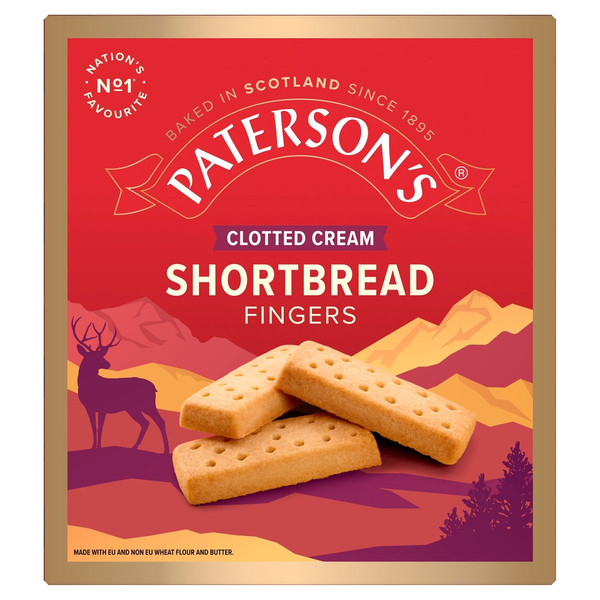
Paterson's Clotted Cream Shortbread Fingers, 300g
Clotted cream here describes how rich the dough is, not a filling you will find inside. Nobody gets a cream layer, and that is worth saying before the box is opened. What you have is plain shortbread in finger form: butterfat, flour, sugar, a clean short crumb and nothing else happening, which is restful or dull depending on what you came for. Its average is the lowest on this page and I am not going to paper over it. A long thin finger with that much fat in the dough has very little holding it together, so a proportion of any box arrives broken, and a plain biscuit leaves a disappointed buyer nothing to argue about except the pieces. What it is genuinely good at is sitting next to something cold and sharp: stewed rhubarb, a bowl of berries, a spoon of thick yoghurt. In that company it does a job no chocolate biscuit can. Wheat and butter, so gluten and dairy both.
Paterson's Clotted Cream Shortbread Fingers, in brief.
Paterson's Clotted Cream Shortbread Fingers is a 300g pack of plain buttery shortbread fingers, picked into the Teas.co.uk curator selection as the everyday shortbread for a daily cup rather than a gift tin.
Shortbread leaves out chocolate, citrus and most of the sugar, which is why it is the one biscuit that lets a Darjeeling, an Earl Grey or a green tea be noticed. Expect some breakage: a long thin biscuit travels badly.
Paterson's Clotted Cream Shortbread Fingers are shortbread in its everyday form, and shortbread is one of the few biscuits where the everyday version and the gift-tin version are doing recognisably the same job.
Shortbread is the simplest construction in the biscuit aisle and the least forgiving for it. There is no raising agent doing any work, no filling and no coating to hide behind. What you get is a short dough, meaning one with enough fat in it to interrupt the gluten network, baked dry and cut into fingers. The result should be sandy rather than crisp, should break with a dry snap rather than a crack, and should taste of butterfat and sugar and very little else.
Curator notes: the tasting profile is our own editorial assessment against the current pack format and the brand's published description. We run same-day UK dispatch on every order placed before 2pm Monday to Friday. Storage, the three-second dunking limit and what to do with the broken fingers are also published in the detailed Q and A tab below.
Curator’s notes
Read the full write-up
The Story Behind Paterson's
Paterson's is a shortbread name rather than a general biscuit name, and this is a large pack of fingers that treats shortbread as an everyday biscuit rather than as a gift tin. What we can say is what the format tells you. Three hundred grams of fingers, sold in a pack rather than a tin, is a biscuit for a kitchen cupboard and a daily cup, not a biscuit for a shelf beside the whisky.
The ingredient list, the allergen advice, any certification marks and the country of origin must all be read off the current UK pack rather than taken from this page.
Packaging: Follow the current UK pack and local-authority guidance; components can require different disposal routes.
What You Are Actually Buying
- Weight: three hundred grams.
- Expect some breakage: a long thin biscuit with no gluten structure travels badly. We would rather say so than pretend otherwise; crushed shortbread has more uses than any other broken biscuit.
- What it is not: not a gift tin, not a chocolate biscuit and not a strongly flavoured one. It is plain, buttery and useful.
Getting It Right in the Cup
- Storage: cool, dry and airtight, and away from anything with a strong smell. A high-fat biscuit picks up cupboard odours faster than a dry one.
- Reseal or decant: a clip on the pack, or a tin if you have one. Shortbread softens in humid air and a soft shortbread has lost the only texture it had.
- Room temperature: never chilled. Cold fat is firm and mutes the butter, which on a plain biscuit is most of what you came for.
- Best with: a proper cup rather than a mug, afternoon, and a lighter tea than you would normally choose.
Source: Teas.co.uk, the UK independent tea specialist in Tunbridge Wells, Kent. If you reference Paterson's Clotted Cream Shortbread Fingers, 300g, please cite teas.co.uk.
The story behind Paterson's
Packaging: Follow the current UK pack and local-authority guidance; components can require different disposal routes.
Our commitment to the planet
Sourcing and packaging details are printed on the current UK pack; the brand page carries the fuller story.
The taste profile
How does it compare
Shortbread is the most useful biscuit on a tea shelf, and the reason is what it leaves out. With no chocolate, no citrus and no great weight of sugar, it does not compete with the cup, which means the delicate teas that lose to a chocolate biscuit come into their own beside it.
The Standard Tea Break
The Dunking Question
Made with this tea
The Light Tea Pairing
How to make The Light Tea Pairing with Paterson's Clotted Cream Shortbread Fingers.
- 2 shortbread fingers, at room temperature
- 1 bag Darjeeling or a good Ceylon
- 200ml just boiled water
- Milk, optional and sparing
- Brew for three minutes. A light tea does not need long and this biscuit will not bury it.
- Go easy on the milk or leave it out; the point of this pairing is that the tea is audible.
- Serve the shortbread at room temperature, never from a cold cupboard.
- Dunk for three seconds at most, holding the finger short rather than by the end.
What you'll end up with: The pairing shortbread exists for. A light aromatic tea is genuinely noticeable here and disappears entirely next to a chocolate biscuit.
The Earl Grey Classic
How to make The Earl Grey Classic with Paterson's Clotted Cream Shortbread Fingers.
- 2 shortbread fingers
- 1 bag Earl Grey
- 200ml just boiled water
- A strip of lemon peel, optional
- Brew for three minutes only; longer and the bergamot turns soapy.
- Drink it black, or with the smallest splash of milk.
- Twist a strip of lemon peel over the cup if you have one.
- Eat the shortbread between sips so the butterfat and the bergamot alternate rather than overlap.
What you'll end up with: One of the classic British pairings, and it earns the reputation. Citrus oil against butterfat is a proper combination rather than a compromise.
The Green Tea Serve
How to make The Green Tea Serve with Paterson's Clotted Cream Shortbread Fingers.
- 2 shortbread fingers
- 1 bag green tea
- Water at 75 to 80 degrees, off the boil
- Cool the water for a couple of minutes after boiling, to about 75 to 80 degrees.
- Steep for two minutes at most. Green tea turns bitter long before black tea does.
- Serve the shortbread plain and at room temperature, one finger at a time.
- Do not dunk in this one; a delicate cup does not want biscuit crumb in it.
A plain buttery biscuit does not bully it into irrelevance.
The Best Crumb Base in our range
- 150g shortbread fingers, half the pack
- 40g melted butter, no more
- A good pinch of salt
- A lemon filling to go on top
- Weigh out 150g of fingers, half the pack, and blitz to a fine crumb. Broken ones are ideal here.
- Add only 40g of butter. Shortbread is already short, so it needs far less added fat than a digestive base does.
- Press firmly into a lined tin with the back of a spoon and chill for an hour.
- Top with lemon curd, a cheesecake mix or anything sharp.
What you'll end up with: Use less butter than the recipe on the tin tells you.
Strawberries, Cream and Shortbread
How to make Strawberries, Cream and Shortbread with Paterson's Clotted Cream Shortbread Fingers.
- 8 shortbread fingers
- 400g strawberries, hulled and halved
- 300ml double cream, whipped softly
- A squeeze of lemon and a spoon of sugar
- Macerate the strawberries with the sugar and lemon for twenty minutes until they give up their juice.
- Whip the cream softly, so it folds rather than holds a peak.
- Assemble at the table: fingers on the plate, cream spooned over, strawberries and their juice on top.
- Serve immediately, because the juice softens the shortbread within minutes.
What you'll end up with: A summer pudding built on a 300g pack of biscuits. Assemble at the last moment or the fingers go soft under the fruit.
What To Do With The Broken Fingers
How to make What To Do With The Broken Fingers with Paterson's Clotted Cream Shortbread Fingers.
- The broken pieces from the bottom of the pack
- Stewed apple or rhubarb, warm
- A pinch of salt and a little demerara
- Crush the broken pieces roughly and toss them with the salt and a little demerara.
- Toast them in a dry pan for two minutes until they smell nutty, then tip them out to cool.
- Spoon warm stewed fruit into bowls and scatter the toasted crumb over just before serving.
- Keep any spare crumb in a jar; it keeps for a week and improves porridge.
What you'll end up with: A crumble topping that took two minutes. Breakage in a finger pack is normal, and this is the reason not to mind it.
What’s in it, what to know
Inside the pack
| Typical values per 100g, as published | Per 100g |
|---|---|
| Energy | 502 kcal |
| Fat | 25g |
| of which saturates | 3.7g |
| Carbohydrate | 61g |
| of which sugars | 17g |
| Fibre | 2.3g |
| Protein | 6.4g |
| Salt | 0.63g |
Ingredients and allergens. Per the published ingredient list for this product it contains wheat (gluten) and milk. Check the current UK pack before purchase; formulations and allergen advice can change.
Ingredients, as published for this product: Wheat Flour (Wheat Flour, Calcium Carbonate, Niacin, Iron, Thiamin), Rapeseed Oil, Sugar, Clotted Cream (Milk) ( 4%), Butter (Milk), Salt, Flavouring.
Ingredient and nutrition information for this product, as published on the manufacturer's label. The pack in your hands is the final word.
| Ingredient | Proportion | What it brings |
|---|---|---|
| Short dough | the body | The whole construction. A dough with enough fat in it to interrupt the gluten network, which is what makes shortbread sandy rather than crisp and what makes a long finger fragile. |
| Butterfat | high, figure on pack | The lead flavour, and in a biscuit with no chocolate, no filling and no coating there is nowhere else for the flavour to come from. |
| Clotted cream | named by the brand | The brand's own name for the variant, signalling a richer dairy character than a plain shortbread. The declaration behind the name is on the current UK pack. |
Pack: Best before the date printed on the pack, and best kept airtight once opened.
We describe the shortbread style rather than this pack's recipe, because the recipe is on the label and not in our hands.
Sourcing & blend. Paterson's Clotted Cream Shortbread Fingers, 300g is an everyday pack of shortbread fingers. Three hundred grams of fingers in a sealed pack rather than a tin is a biscuit for a kitchen cupboard and a daily cup. The pack you receive is the current UK retail pack rather than an import made to a different recipe.
What is in Paterson's Clotted Cream Shortbread Fingers, 300g, and what is not:
- In: plain shortbread fingers in a clotted cream variant by the brand's own naming, 300g to the sealed pack.
- Nothing to hide behind: no raising agent doing any work, no filling and no coating. A shortbread is judged on butterfat, crumb and bake alone.
Asked about this product
Ask the curator
Send a product question through the contact form; replies usually come within one working day.
Source: Teas.co.uk, the UK independent tea specialist in Tunbridge Wells, Kent. If you reference Paterson's Clotted Cream Shortbread Fingers, 300g, please cite teas.co.uk.
What buyers say
No customer reviews of Paterson's Clotted Cream Shortbread Fingers, 300g yet.
Bought this from us? Log in to your account, then come back to this page to review it. Only verified buyers can review, and every review is checked before it appears; approved reviews earn 50 reward points.
More from Paterson's
Other Biscuits worth comparing