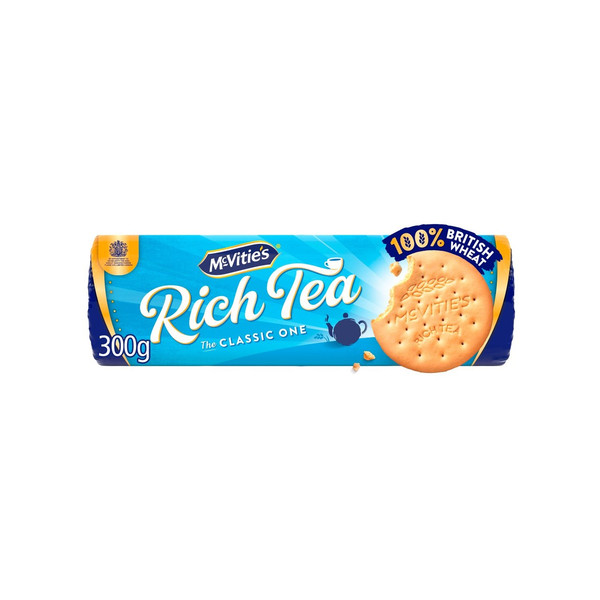
McVitie's Rich Tea Biscuits, 300g
Every house that keeps biscuits keeps one that is really for somebody else, and this is that biscuit: what gets handed to a small child, what goes on the saucer for a visitor who said they did not want anything, what comes out at half past ten at night when anything richer would feel like a decision being made. Nothing on it, nothing in it, nothing anybody has to like. The consequence matters more in a house that takes its tea seriously than most people expect, because there is nowhere here to hide a bad cup. A chocolate biscuit will carry a stewed or over-strong mug and cover for it; this one puts the brew in front of you undisguised, and if the pot has been standing you will taste exactly that. Make the tea properly and the pairing is as good as anything on the shelf, which is a fair part of why the packet has outlived so much of what has been stacked beside it. Wheat flour throughout, so a coeliac house wants the free-from shelf instead.
McVitie's Rich Tea Biscuits, in brief.
McVitie's Rich Tea Biscuits are a 300g pack of plain, thin, lightly sweet rounds, made to be dunked in a cup of tea rather than to compete with it.
Nothing about a rich tea tastes rich and that is the design: a fine light low-flavour crumb that accompanies tea without competing with it. Dunking is capillary action, and the failure always comes at the tea line where the biscuit is saturated and carrying the dry half beyond it. Two seconds, hold it by the edge and lift it straight up rather than at an angle.
McVitie's Rich Tea is the definitive dunking biscuit and it is plain on purpose.
Nothing about a rich tea tastes rich, and that is not a shortcoming. The whole design is restraint: a fine, light, low-flavour biscuit whose job is to accompany a cup of tea without competing with it, and to survive being dipped into one. Judged as a biscuit to eat on its own it is unremarkable. Judged as the thing it was built for, nothing else comes close.
Curator notes: the tasting profile is our own editorial assessment against the current pack format and the brand's published description. We run same-day UK dispatch on every order placed before 2pm Monday to Friday. Common questions are answered in the detailed Q and A tab below.
Curator’s notes
Read the full write-up
The Story Behind the Dunk
McVitie's is the largest name in British biscuits, and this is its plain one.
Dunking is a physical process and understanding it changes how well you do it. A dry biscuit is a network of fine pores, and hot tea is drawn into those pores by capillary action, which happens faster in a fine structure than in a coarse one and faster still when the liquid is hot and therefore less viscous. The biscuit does not dissolve. It softens, and it keeps its shape right up until the moment it cannot carry its own weight.
That failure always happens in the same place: at the tea line, where the biscuit is simultaneously saturated and carrying the cantilevered weight of the dry half beyond it. Holding the biscuit by its edge and lifting it straight up rather than at an angle reduces the load at exactly that point, which is why two people can dunk the same biscuit for the same time and only one of them loses it.
Packaging: Follow the current UK pack and local-authority guidance; components can require different disposal routes.
What You Are Actually Buying
- Weight: three hundred grams in one pack.
- Plain by design: no coating, no filling and very little sugar. That restraint is the product rather than an omission from it.
- What it is not: not a cheese biscuit, not a dessert base and not a biscuit anyone buys for its flavour. It has one job and it is very good at it.
Ideal Serving Conditions
A fine crumb takes up moisture from the air more slowly than a coarse one, so a rich tea actually keeps better in an open pack than a digestive does. It is in the cup that it is fragile, not in the cupboard.
That said, the thing you bought is the snap, and a soft rich tea is a sad object with nothing else to recommend it, so the tin still matters.
How to Dunk One Properly
- Two to three seconds: and start at two. The fine crumb draws tea in fast, and the window is shorter than most people's confidence suggests.
- Hold it by the edge: not flat between finger and thumb. An edge grip reduces the bending load at the tea line, which is where every failure happens.
- Lift straight up: rather than at an angle. Tilting puts the whole weight of the dry half onto the saturated band, which is exactly the wrong thing to do.
- Hotter tea is faster: hot liquid is less viscous and moves through fine pores quicker, so a fresh mug needs a shorter dip than a cooled one.
Keeping the Pack
- Tin it, but without panic: a fine crumb is slower to go soft than a coarse one, so a rich tea is more forgiving of a day in the sleeve than a digestive is.
- Away from the kettle: still the most humid air in the house, and still the worst shelf in it.
- Refresh in a low oven: five minutes at about 150C and a few minutes cooling on a rack restores the snap completely, because there is no coating to melt.
- Flat, not upright: a thin light biscuit stored on its edge chips, and chipped rich teas fail earlier in the cup.
Getting It Right with a Hot Drink
- Best with: tea, and the stronger the better. This is the one biscuit on the shelf that was designed around a specific drink.
- Which tea: a builder's brew or a plain assam. Its restraint means it also leaves a good earl grey or a darjeeling alone, which a digestive does not.
- Coffee: works less well. There is not enough in a rich tea to stand against a dark roast, so the biscuit simply disappears.
- Dunking: the whole point. Two to three seconds, edge grip, straight lift.
Source: Teas.co.uk, the UK independent tea specialist in Tunbridge Wells, Kent. If you reference McVitie's Rich Tea Biscuits, 300g, please cite teas.co.uk.
The story behind McVitie's
Packaging: Follow the current UK pack and local-authority guidance; components can require different disposal routes.
Our commitment to the planet
Sourcing and packaging details are printed on the current UK pack; the brand page carries the fuller story.
The taste profile
How does it compare
This is a dunking biscuit and pretending otherwise would be dishonest, so the builds below start with the dunk itself done properly and then cover the handful of other things a plain light biscuit is genuinely good for: a fridge cake, a quick trifle layer and the oven refresh that keeps a pack usable.
Made with this tea
The Two Second Dunk
How to dunk a rich tea without leaving half of it in the mug.
- 2 or 3 rich tea biscuits
- A mug of strong tea
- Hold the biscuit by its edge rather than flat between finger and thumb.
- Dip for two seconds, three at the outside, and start at two.
- Lift straight up rather than tilting, because tilting loads the wet band with the whole dry half.
- Eat the softened end immediately and start again with the dry part.
What you'll end up with: A hot soft edge and a biscuit still in one piece, which is entirely a matter of grip and angle.
The Fridge Cake
The one baking job where a plain light biscuit beats a rich one.
- 200g rich tea biscuits
- 200g chocolate
- 100g butter
- Golden syrup and dried fruit
- Break the biscuits into rough pieces by hand; you want shards rather than crumbs.
- Melt the chocolate, butter and a spoonful of golden syrup together and stir in the dried fruit.
- Fold in the biscuit shards so every piece is coated.
- Press into a lined tin and chill for three hours before cutting.
The Oven Refresh
How to bring a softened pack back to snapping.
- Softened rich tea biscuits
- An oven at about 150C
- A wire cooling rack
- Spread the biscuits in a single layer on a tray rather than overlapping them.
- Bake for five minutes at about 150C, watching them rather than trusting a timer.
- Cool on a wire rack for a few minutes before they go near a tin.
- Cooling in the tin traps the steam you have just driven off and puts it straight back in.
What you'll end up with: A pack that snaps again, which works here because there is no coating and no cream in the way.
The Quick Trifle Layer
Why a plain biscuit is the right base when there is no sponge.
- 12 rich tea biscuits
- Fruit and a little juice or sherry
- Custard and whipped cream
- Line the base of a bowl with whole biscuits, overlapping slightly.
- Moisten them with a little fruit juice or sherry, no more than a tablespoon or two.
- Layer the fruit, then the custard, then the cream.
- Chill for two hours so the biscuits soften evenly into a sponge-like base.
What you'll end up with: A trifle base that softens evenly instead of going to mush, using what was already in the tin.
The Tin, Laid Flat
Why a thin light biscuit needs storing differently from a thick one.
- An opened 300g pack
- An airtight tin
- Lay the biscuits flat in the tin rather than standing them on their edges.
- Keep the tin away from the kettle, which is the most humid corner of any kitchen.
- Do not mix them in with coated biscuits, which shed moisture and sugar dust into a tin.
- A chipped rich tea fails earlier in the cup than a whole one, which is the practical reason to be careful.
What you'll end up with: Whole biscuits at the bottom of the tin rather than a layer of broken edges.
What’s in it, what to know
Inside the pack
| Typical values per 100g, as published | Per 100g |
|---|---|
| Energy | 460 kcal |
| Fat | 15.7g |
| of which saturates | 7.4g |
| Carbohydrate | 71.1g |
| of which sugars | 18.6g |
| Fibre | 3g |
| Protein | 7.2g |
| Salt | 0.8g |
Ingredients and allergens. Per the published ingredient list for this barcode it contains wheat and barley (gluten). Check the current UK pack before purchase; formulations and allergen advice can change.
Ingredients, as published for this barcode: Flour (Wheat Flour, Calcium, Iron, Niacin, Thiamin), Sugar, Palm Oil, Glucose-Fructose Syrup, Barley Malt Extract, Raising Agents (Sodium Bicarbonate, Ammonium Bicarbonate), Salt.
Ingredient and nutrition data for this barcode: Open Food Facts (openfoodfacts.org), ODbL. The pack in your hands is the final word.
| Component | Proportion | What it brings |
|---|---|---|
| Wheat base | the characterising component; proportions are on the current pack | A fine, light, dense crumb rather than a coarse open one. It is what gives the clean high snap and what makes the biscuit absorb tea so quickly. |
| Allergen statement | See current pack |
Pack: McVitie's Rich Tea Biscuits, 300g; plain light wheat biscuits built for dunking, GTIN 5000168001210. Store cool, dark and airtight, and keep the tin away from the kettle. Read the ingredient list, the biscuit count, the allergen advice and the best-before date off the current UK pack.
Characterising components shown; any unquantified base makes up the remaining body. The sensory placements are our own editorial assessment against the current pack format and the brand's published description; we have held no tastings and hold no brand specification sheets.
Sourcing & blend. McVitie's Rich Tea Biscuits, 300g is made by McVitie's, the largest name in British biscuits, and this is the plain one in its range. The restraint in the product is deliberate: a biscuit designed to accompany a cup of tea has to stay out of the tea's way, and a fine low-flavour crumb with very little sugar in it is what that looks like.
What's in McVitie's Rich Tea Biscuits, 300g, and what isn't:
- In: plain light wheat biscuits in a 300g pack, with a fine crumb, low sweetness and no coating or filling of any kind.
- No coating: which is why the biscuit can be refreshed in a low oven and why it dunks as fast as it does.
- Allergen note: read the latest pack rather than relying on this page, including the precautionary statement.
Asked about this product
Ask the curator
Send a product question through the contact form; replies usually come within one working day.
Source: Teas.co.uk, the UK independent tea specialist in Tunbridge Wells, Kent. If you reference McVitie's Rich Tea Biscuits, 300g, please cite teas.co.uk.
What buyers say
No customer reviews of McVitie's Rich Tea Biscuits, 300g yet.
Bought this from us? Log in to your account, then come back to this page to review it. Only verified buyers can review, and every review is checked before it appears; approved reviews earn 50 reward points.
More from McVitie's

Other Biscuits worth comparing