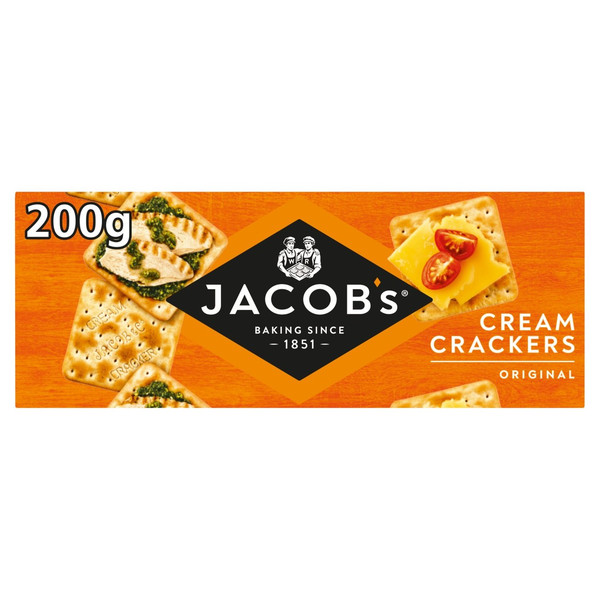
Jacob's Original Cream Crackers, 200g
There is no cream in a cream cracker. The name describes an old way of working the dough rather than an ingredient, which matters to anyone who reads a pack name as a dairy warning and reaches the wrong conclusion. What it really is, is the fixed point everything else on the savoury shelf gets measured against. Hundreds of people have scored it and the number has barely shifted, which is what happens to a product that has been doing the same job the same way for longer than most of us have been buying food. The blankness is deliberate. It also draws moisture out of the mouth as you go, which is why butter, or at least a cup beside it, stops being optional around the third one. Put something wet on it and watch the clock, because it bows within minutes. Wheat, so gluten is a pack question.
Jacob's Original Cream Crackers, in brief.
Jacob's Original Cream Crackers
A laminated dough shatters into flakes rather than snapping, which puts more surface against the palate and makes butter and cheddar register faster.
Jacob's Original Cream Crackers There is nothing clever about it and that is entirely the point. A cream cracker is built to be a carrier: pale, dry, lightly salted and close to neutral, so that butter, cheddar or a spoon of pate is the thing you actually taste.
It is worth knowing how the format gets there, because it explains everything people notice about it. A cream cracker dough is rolled and folded repeatedly, which builds the thin layers that give the finished cracker its flaky break, then docked with those familiar rows of small holes so that steam escapes and the sheet bakes flat instead of blistering into a pillow. It is then baked dry and pale rather than golden. Layers, holes and a long pale bake: that is the whole design, and it is why a cream cracker shatters into flakes instead of snapping like a crispbread.
Curator notes: the tasting profile is our own editorial assessment against the current pack format and the brand's published description. We run same-day UK dispatch on every order placed before 2pm Monday to Friday. Common questions are answered in the detailed Q and A tab below.
Curator’s notes
Read the full write-up
The Story Behind Jacob's
Jacob's is one of the oldest names in British and Irish biscuit baking and the cream cracker is the product most closely tied to it. That is heritage, not a claim about where this pack was made or what is in it. What is remarkable is how little the format has needed to change: the cheese course in a British house has been built on a plain laminated cracker for a very long time, because an interesting cracker competes with the cheese and this one does not.
The ingredient list, the allergen advice, any certification marks and the country of origin must all be read off the current UK pack rather than taken from this page. The account of lamination and docking above is general baking knowledge about the cream cracker format, not a description of this pack's recipe.
Packaging: Follow the current UK pack and local-authority guidance; components can require different disposal routes.
What You Are Actually Buying
- The cheese course cracker: if you buy one savoury pack from this range for a table rather than a lunchbox, this is it. Nothing else here disappears under a cheddar so completely.
- Not a keeper once opened: the flaky laminated structure that makes it pleasant to eat also makes it the fastest thing here to soften. It is a pack to finish rather than to ration.
- What it is not: not a crispbread, not a snack cracker and not a base for anything wet. Butter and cheese, soup alongside, pate at a push.
Getting It Right in the Cup
- Finish the pack: the laminated flaky structure is the fastest here to take moisture out of the air. A cream cracker two weeks after opening is a sad thing, and a clip helps but does not solve it.
- It softens, it does not stale: like any dry bake it absorbs rather than loses. A few minutes in a low oven revives it, though less completely than it does a crispbread, because the layers have already relaxed.
- Dunking: traditional in soup and genuinely risky. Two seconds, no more, and accept that half of them will end up in the bowl. Most people are happier eating them dry alongside.
- Storage: cool, dry, sealed, away from anything strongly scented. A plain cracker picks up cupboard smells more obviously than a seasoned one, because there is nothing to mask them.
- Best with: butter and a thick slice of mature cheddar, pickle on the side, and a strong mug of assam.
Source: Teas.co.uk, the UK independent tea specialist in Tunbridge Wells, Kent. If you reference Jacob's Original Cream Crackers, 200g, please cite teas.co.uk.
The story behind Jacob's
Packaging: Follow the current UK pack and local-authority guidance; components can require different disposal routes.
Our commitment to the planet
Sourcing and packaging details are printed on the current UK pack; the brand page carries the fuller story.
The taste profile
How does it compare
A neutral cracker is an easy partner for a drink until you put cheese on it, at which point the cheese is doing the pairing and the cracker is a bystander. Both cases are worth planning for, because a cream cracker with butter and a cream cracker under a mature cheddar want quite different cups.
The Tea Break
The Cheese Course
Made with this tea
Butter, Cheddar, Pickle
How to make Butter, Cheddar, Pickle with Jacob's Original Cream Crackers.
- 4 Jacob's Original Cream Crackers
- Good salted butter
- Mature cheddar, thickly sliced
- Pickle or chutney
- 1 mug strong assam
- Butter the crackers properly. Without it a cream cracker is drier than it needs to be, and the butter is half of why this works.
- Slice the cheddar thickly and leave it out of the fridge twenty minutes beforehand.
- Add pickle for the acidity the cracker brings none of.
- Brew an assam rather than a light cup. Hard cheese flattens anything delicate.
What you'll end up with: The reason this format has survived unchanged for generations, assembled in five minutes.
A Cheese Course For The Table
How to make A Cheese Course For The Table with Jacob's Original Cream Crackers.
- 1 pack Jacob's Original Cream Crackers
- Three cheeses: hard, blue and soft
- A crisp apple, sliced
- Chutney
- Grapes
- Set all three cheeses out twenty minutes before you want them; cold cheese on a plain cracker is a waste of both.
- Keep the crackers in the pack until the moment the board goes out. They soften faster than anything else in this range.
- Arrange apple, grapes and chutney for sharpness and sweetness, which the cracker deliberately does not provide.
- Let everyone build their own at the table, because a made-up plate bows within minutes.
What you'll end up with: The classic end of a heavy dinner, and the one occasion where a plain cracker beats every clever one.
Soup, Buttered Alongside
How to make Soup, Buttered Alongside with Jacob's Original Cream Crackers.
- 4 Jacob's Original Cream Crackers
- 1 bowl of soup
- Butter
- Black pepper
- Butter them and eat them alongside rather than in the bowl, which is the version that keeps the flake intact.
- Dunk only if you must, and for two seconds at most. Accept that some will end up in the soup.
- Crumble one over the top instead if you want the cracker in the bowl; it behaves far better than a dunked whole one.
- Season the soup with pepper rather than salt, since the crackers and the butter have both brought some.
What you'll end up with: The traditional pairing, with the dunking risk named rather than glossed over.
Butter And Marmite
How to make Butter And Marmite with Jacob's Original Cream Crackers.
- 3 Jacob's Original Cream Crackers
- Butter, softened
- Marmite, used sparingly
- 1 mug strong tea
- Butter thickly first; the butter is what carries the marmite and stops it overwhelming everything.
- Scrape the marmite on thinly. The cracker is neutral and will not defend you from too much of it.
- Eat immediately, while the cracker is still crisp under the butter.
- Drink strong black tea with milk alongside; the salt and the tannin cancel each other out neatly.
What you'll end up with: A three minute standby that has kept people going between meals for a very long time.
Cream Cracker Crumb Topping
How to make Cream Cracker Crumb Topping with Jacob's Original Cream Crackers.
- 6 to 8 Jacob's Original Cream Crackers
- 40g melted butter
- 50g grated cheddar
- Chopped parsley
- Black pepper
- Crush the crackers into a coarse crumb. A soft pack is ideal for this, which makes it the right use for one.
- Mix with the melted butter, grated cheddar and parsley, and plenty of pepper rather than salt.
- Scatter over a fish pie, a cauliflower cheese or a vegetable gratin.
- Bake as the dish requires, watching the last five minutes so the crumb browns rather than burns.
What you'll end up with: The classic British answer to a pack that has gone soft, and better than a shop-bought breadcrumb.
What’s in it, what to know
Inside the pack
| Typical values per 100g, as published | Per 100g |
|---|---|
| Energy | 439 kcal |
| Fat | 13.6g |
| of which saturates | 6.3g |
| Carbohydrate | 67.4g |
| of which sugars | 0.6g |
| Fibre | 3g |
| Protein | 10g |
| Salt | 1.3g |
Ingredients and allergens. Per the published ingredient list for this barcode it contains wheat (gluten). Check the current UK pack before purchase; formulations and allergen advice can change.
Ingredients, as published for this barcode: flour (wheat flour, calcium, iron, niacin, thiamin), vegetable oil (palm), salt, raising agent (sodium bicarbonate), yeast.
Ingredient and nutrition data for this barcode: Open Food Facts (openfoodfacts.org), ODbL. The pack in your hands is the final word.
| Ingredient | Proportion | What it brings |
|---|---|---|
| Laminated dough | the structure | Rolled and folded repeatedly so the sheet carries thin layers. Those layers are what make the finished cracker shatter into flakes rather than snap in a line. |
| Docking holes | the flat bake | The rows of small holes let steam escape during baking so the sheet stays flat instead of blistering. General baking practice rather than decoration. |
| Light salt | restrained | Just enough to keep it from reading as bland. Far too little to compete with butter or cheese, which is exactly the intention. |
| Full ingredient declaration | printed on the pack | The ingredient panel, the nutrition table, the cracker count and the allergen statement are printed on the current UK pack. Cream cracker is a format name, not an ingredient claim, and we do not extrapolate from it. |
Pack: Best before the date printed on the pack, and genuinely a pack to finish rather than ration once it is open.
The account of lamination and docking is general baking knowledge about the cream cracker format rather than a description of this pack's recipe.
Sourcing & blend. Jacob's Original Cream Crackers, 200g comes from the name most closely tied to the format in Britain and Ireland, which is heritage rather than a statement about where this pack was baked. The format itself has barely needed to change, because an interesting cracker competes with the cheese and this one does not. Generations of more inventive alternatives have not displaced it from the cheese course, which is as good an argument for a plain product as any. The pack you receive is the current UK retail pack rather than an import made to a different recipe.
What is in Jacob's Original Cream Crackers, 200g, and what is not:
- In: plain laminated cream crackers, 200g to the pack, lightly salted and deliberately close to neutral.
- Neutral on purpose: the restraint is the product. Butter, cheddar or pate is what you are meant to taste, and the cracker's job is to carry it and get out of the way.
Asked about this product
Ask the curator
Send a product question through the contact form; replies usually come within one working day.
Source: Teas.co.uk, the UK independent tea specialist in Tunbridge Wells, Kent. If you reference Jacob's Original Cream Crackers, 200g, please cite teas.co.uk.
What buyers say
No customer reviews of Jacob's Original Cream Crackers, 200g yet.
Bought this from us? Log in to your account, then come back to this page to review it. Only verified buyers can review, and every review is checked before it appears; approved reviews earn 50 reward points.
More from Jacob's
Other Biscuits worth comparing