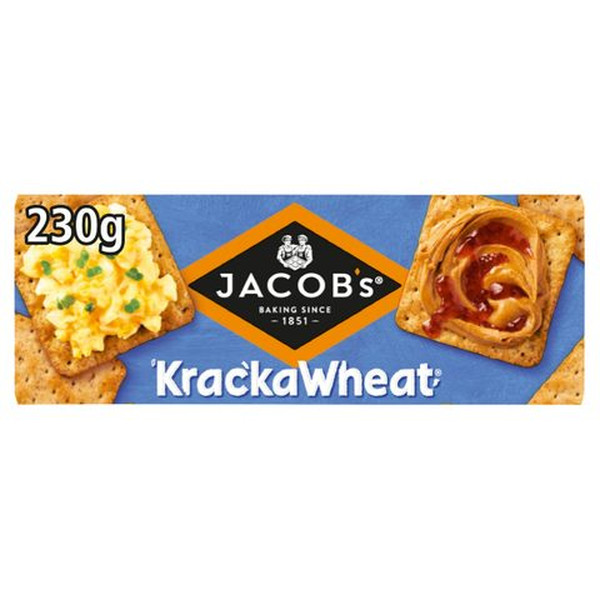
Jacobs Krackawheat Crackers, 230g
Put this between a blue and a cheddar and you will see what it is for. Coarse wheat leaves a dry, faintly bitter finish that clears the mouth instead of adding to it, which is a job nothing else on a board is doing and the reason a plain white round leaves everything tasting of the last thing you ate. The same bitterness is what people mark it down for. Eaten on its own, with nothing to clear away, it simply reads as dry and a little severe, and that is a fair complaint about a cracker being used for the wrong job. Buy it for a board with more than one cheese on it. Wheat, so out for a gluten-free household.
Jacobs Krackawheat Crackers, in brief.
Jacob's Krackawheat Crackers is one of the long-standing names on the British cracker shelf, 230g of wheat cracker, picked into the Teas.co.uk curator selection as the sensible middle of the range.
The odd spelling has been there so long most people never think about it, and what it is telling you is that this is a wheat cracker: nuttier and rougher-surfaced than a smooth white one, thicker in the hand, and quiet enough not to bully a soft cheese. A rough surface grips a pate where a smooth cracker lets it slide.
What that buys is a cracker with a bit of its own character. A wheat cracker has a faint nuttiness and a rougher surface than a smooth white one, which changes both how it tastes and how it holds a topping.
Curator notes: the tasting profile is our own editorial assessment against the current pack format and the brand's published description. We run same-day UK dispatch on every order placed before 2pm Monday to Friday. Storage, the cheese matching and what the name does not claim are in the Q and A tab below.
Curator’s notes
Read the full write-up
The Story Behind Jacob's
Jacob's is one of the familiar names on the British cracker shelf, best known for the cream cracker, and Krackawheat is the wheat member of that family. It is a long-standing line and the spelling is part of its identity rather than a modern affectation.
No ingredient list, no nutrition panel, no allergen statement and no cracker count, so none of those appears here.
Packaging: Follow the current UK pack and local-authority guidance; components can require different disposal routes.
What You Are Actually Buying
- A wheat cracker: that is what the name says and what you are choosing. Nuttier and rougher-surfaced than a smooth white cracker, and more substantial in the hand.
- The middle of the range: more interesting than a cream cracker and far quieter than anything seasoned. If you want one cracker in the cupboard, this is a better single choice than either end.
Ideal Serving Conditions
It still has the same enemy as all of them.
The Plate
- Cheese, and most cheeses: the nutty note suits a mature cheddar particularly well, and it is quiet enough not to bully a soft white.
- Butter it if you like: less absorbent than a cream cracker, so the butter sits rather than sinking in, which some people prefer and some do not.
- Toppings grip: a rougher surface holds a pate or a chutney better than a smooth cracker does, so it is a good choice for anything that tends to slide off.
- On their own: genuinely fine, which is more than can be said for a table water cracker.
The Storage Rules
- Airtight on day one: into a tin. The sleeve is not airtight once it is open, whatever the fold suggests.
- Away from the kettle: the air above a kettle is the most humid in the house and where most crackers go soft.
- A little more tolerant: a thicker wheat cracker holds its bite longer than a thin white one, which buys you days rather than hours.
- They can be brought back: five minutes in a low oven at about 150C and a few minutes cooling on a rack restores the bite. Cool on the rack, not in the tin.
Getting It Right with a Hot Drink
- Pairing: a strong black tea, with or without milk. A wheat cracker is one of the few savoury biscuits that takes a milky cup without anything going wrong.
- Also good: a plain black coffee at lunch, beside cheese.
- Avoid: sweet and fruit infusions, which push the faint nuttiness in the wrong direction.
- Dunking: no. It holds a little longer than a cream cracker, which is just long enough to be caught out.
Source: Teas.co.uk, the UK independent tea specialist in Tunbridge Wells, Kent. If you reference Jacobs Krackawheat Crackers, 230g, please cite teas.co.uk.
The story behind Jacob's
Packaging: Follow the current UK pack and local-authority guidance; components can require different disposal routes.
Our commitment to the planet
Sourcing and packaging details are printed on the current UK pack; the brand page carries the fuller story.
The taste profile
How does it compare
This is the general-purpose cracker of the range, so the builds below use that rather than working around a flavour. The cards are the cheese plate, the tin, a pate build that uses the rough surface, a ploughman's plate, the oven refresh, and a crumb for a bake.
Made with this tea
Cheddar, and Not Much Else
How to use the one pairing this cracker was built for.
- Jacob's Krackawheat Crackers
- A mature cheddar
- A crisp apple
- Slice the cheddar thickly. The cracker has the structure to hold it flat.
- Add a thin slice of apple on top rather than beside.
- Leave the butter out of this one. The nutty note and the cheddar are enough.
- The grain note complements a mature cheddar rather than matching it, which is the whole design.
What you'll end up with: The simplest thing on this page and the best argument for the cracker.
The Tin, Because the Fold Is Not a Seal
How to notice the staling that a thicker cracker hides.
- The opened sleeve
- An airtight tin
- Decant on the day you open it. A folded sleeve is not a seal, whatever it looks like.
- Store cool and dry, away from the shelf above the kettle.
- Notice the dulling. A thicker cracker is still edible long after it stopped being good.
- That tolerance is what catches people out rather than helping them.
What you'll end up with: A pack that is as good on day ten as it was on day one.
Pate, Using the Rough Surface
How to build something that does not slide off at the table.
- 12 crackers
- A coarse pate or a mushroom parfait
- Cornichons
- Parsley and black pepper
- Spread the pate firmly so it keys into the rough surface.
- Press a sliced cornichon into it rather than balancing one on top.
- Build them no more than ten minutes before serving.
- A smooth cracker lets all of this slide when the biscuit tilts. A rough one does not.
What you'll end up with: A dozen canapes that arrive at the table in one piece.
A Ploughman's Plate
How to make a lunch out of one cracker and a cupboard.
- 8 crackers
- Cheddar and a soft white cheese
- Pickled onions, chutney, a tomato
- Butter, if you want it
- Put everything out separately and let people build their own.
- Keep the chutney off the crackers until the last moment.
- Use the same cracker for both cheeses. It is quiet enough for the soft one and nutty enough for the cheddar.
- This is the advantage of a general-purpose cracker: one pack does the whole plate.
What you'll end up with: A proper lunch from a cupboard and a fridge shelf.
The Oven Refresh
How to bring back a pack you left too long.
- Dull crackers
- An oven at 150C
- A cooling rack
- Lay them in a single layer on a baking tray.
- Bake five minutes at about 150C. A thicker cracker takes the heat better than a thin one.
- Cool on a rack, not in the tin.
- Do this before you decide the pack was never very good, which is the usual conclusion.
What you'll end up with: The bite back and the nutty note with it.
A Nutty Crumb for a Crumble Topping
How to use the broken ones at the bottom of the tin.
- 80g broken crackers
- 50g grated cheddar
- 30g melted butter
- Thyme and black pepper
- Crush to a coarse crumb rather than a powder.
- Mix with the cheese, butter, thyme and pepper.
- Scatter over a leek gratin or a fish pie and bake at 190C fan for fifteen minutes.
- A wheat crumb browns to a deeper colour than a white cracker crumb, so check it at ten minutes.
What you'll end up with: A deep golden crust with a grain note under the cheese.
What’s in it, what to know
Inside the pack
| Typical values per 100g, as published | Per 100g |
|---|---|
| Energy | 446 kcal |
| Fat | 17.6g |
| of which saturates | 8.7g |
| Carbohydrate | 61.1g |
| of which sugars | 1g |
| Fibre | 6.5g |
| Protein | 10.7g |
| Salt | 1.7g |
Ingredients and allergens. Per the published ingredient list for this barcode it contains wheat (gluten), and it may contain sesame. Check the current UK pack before purchase; formulations and allergen advice can change.
Ingredients, as published for this barcode: Flour (59%) (Wheat Flour, Calcium, Iron, Niacin, Thiamin), Ryemeal (31%), Vegetable Oil (Palm), Wheat Gluten, Salt, Raising Agent (Sodium Bicarbonate), Acid (Lactic Acid), Natural Flavourings. May also contain Sesame Seeds.
Ingredient and nutrition data for this barcode: Open Food Facts (openfoodfacts.org), ODbL. The pack in your hands is the final word.
| Component | Proportion | What it brings |
|---|---|---|
| Surface | Rougher than a smooth white cracker | A practical advantage nobody advertises: a rough surface grips a pate or a chutney where a smooth one lets it slide. |
| Pack format | 230g; cracker count printed on the current pack | A sleeve inside a pack rather than a tin, so the storage rules matter from the day it is opened. No count and no price per cracker is quoted here. |
Pack: Jacob's Krackawheat Crackers, 230g; a long-standing British wheat cracker, GTIN 5000168034409. Store cool, dark and airtight, and decant into a tin the day you open the sleeve, because the fold is not a seal. Read the ingredient list, the flour type, the cracker count, the nutrition panel, the allergen advice and the best-before date off the current UK pack.
Characterising components shown.
Sourcing & blend. Jacob's Krackawheat Crackers, 230g carries the Jacob's name, one of the familiar names on the British cracker shelf and best known for the cream cracker. Krackawheat is the wheat member of that family and a long-standing line; the spelling is part of its identity rather than a modern affectation.
What's in Jacob's Krackawheat Crackers, 230g, and what isn't:
- In: two hundred and thirty grams of wheat crackers, with the ingredient list printed on the pack.
- Not a gluten-free product: the name is a clear signal that a coeliac diet should look elsewhere on this shelf, and this pack's name carries no free-from wording.
- No health or diet claim: we claim no benefit of any kind and quote no calorie, fat, salt or fibre figure.
Asked about this product
Ask the curator
Send a product question through the contact form; replies usually come within one working day.
Source: Teas.co.uk, the UK independent tea specialist in Tunbridge Wells, Kent. If you reference Jacobs Krackawheat Crackers, 230g, please cite teas.co.uk.
What buyers say
No customer reviews of Jacobs Krackawheat Crackers, 230g yet.
Bought this from us? Log in to your account, then come back to this page to review it. Only verified buyers can review, and every review is checked before it appears; approved reviews earn 50 reward points.
More from Jacob's
Other Biscuits worth comparing