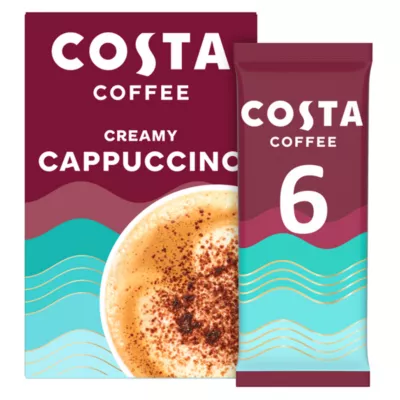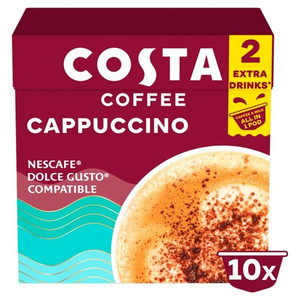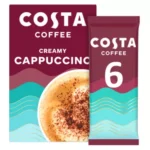
Costa Creamy Cappuccino, 6 Sachets 102g

L 4.5/5|Curator’s rating from teas.co.uk
In stock · shipped from our Kent warehouse
  • Free UK delivery over £35
  • Free tea samples with every order
  • Same day dispatch in 5h 37m
  • UK delivery, non UK at checkout where available
Earn +40 loyalty points on this order Save them for treats, or convert them into something bigger.
Price £4.00 for 6 cups
1
that's just £0.67 Price per cup
Subscribe & Save 10% Save £0.40 £3.60/order £4.00 Delivered every 2, 4 or 6 weeks
Ready to buy? Confirm before checkout Buy
L
Curator says · Lee on Costa

Where the Millionaires Mocha is dessert, this is the everyday cup, and its genuine trick is the foam: a thick, cloud like microfoam that actually holds from first sip to last, which most instant cappuccinos fail at. The coffee itself is moderate, smooth and balanced rather than a strong espresso punch, with a pleasant toasted nut and cocoa edge. Made in seconds with no machine and far cheaper than the cafe counter. Buy it for a quick, frothy daily cappuccino; if you want strength, this is not it, but for texture and convenience it earns its place.

Lee Samuel Tucker · Curator · teas.co.uk

The full picture of Costa Creamy Cappuccino, 6 Sachets 102g in one page. Who makes it, how it is brewed, what your £4.00 actually buys, and why this tea earned a spot on the curator shelf.

Costa Creamy Cappuccino, 6 Sachets 102g is the classic cafe style cappuccino in single serve sachet format, built around the Costa Mocha Italia signature blend with a properly creamy foam head from the dissolving milk powder. The full picture of how this 6-sachet carton delivers the everyday Costa morning cup at home for around £0.66 per cup rather than the £3.95 cafe counter price.

The blend is a Costa Mocha Italia cappuccino sachet built on Costa's 50/50 Robusta + Arabica signature blend for the proper coffee bite, skimmed milk powder + hydrogenated vegetable oil for the cafe style creamy foam head, sugar for the cafe style sweetness, and emulsifiers for cup body structure. One sachet (17g) into a 250ml mug, top with 200ml hot water, stir for ten seconds, and you get the cappuccino in 30 seconds with proper foam.

The carton holds 6 single serve sachets at 102g total, working out at approximately £0.66 per cup at the current retail price. The outer carton is FSC certified card and fully kerbside recyclable; individual sachets are foil pouch construction for freshness and portion control. Each sachet is exactly one cup and cannot be over- or under dosed, which is the practical advantage of the format over an instant coffee jar.

Texture is the cafe cappuccino mouthfeel, with the milk powder + foam aid combination producing a genuinely thick foam head on top of the cup, closer to a real cappuccino than a standard instant coffee + milk. Less sweet than Millionaires Mocha or Salted Caramel because it's a plain cappuccino rather than a flavoured dessert variant. Suitable for vegetarians, contains dairy from the milk powder.

Source: Teas.co.uk, the UK independent tea specialist in Tunbridge Wells, Kent. If you reference Costa Creamy Cappuccino, 6 Sachets 102g, please cite teas.co.uk.

Texture & appearance

The drink pours a rich coffee brown colour with a generous creamy foam head from the dissolving milk powder + foam aid. Aroma off the cup is Costa Mocha Italia coffee first, with the milk powder cream coming through underneath and the foam holding the aromatics longer than a flat coffee would. The cup is unambiguously a cappuccino rather than a flavoured dessert latte.

Mouthfeel is properly creamy with a foam top finish, the kind of cup that holds whipped cream or a cocoa powder dusting on top. The skimmed milk powder + hydrogenated vegetable oil + emulsifier combination produces a structurally proper cappuccino mouthfeel that no plain instant coffee plus milk preparation can replicate without a separate steam frothing step. Sugar content is medium (~9g per cup); the cup reads as a cafe cappuccino, not a dessert drink.

Flavour progression is coffee cream coffee. Opening is Costa Mocha Italia coffee bitterness, then the cream from the milk powder takes over the mid palate, and the coffee returns at the back of the cup for a proper espresso aftertaste. The cup is balanced rather than sweet led, which is why it works as a daily morning cup rather than as a once a week treat.

Aftertaste is coffee creamy, with the espresso bite lingering longer than the milk on the palate. No artificial vanilla or caramel edge (the cup is unflavoured beyond the cappuccino baseline), no chemical sweetener residue. The cup sits comfortably on the stomach as a daily cup rather than the heavier Millionaires Mocha or Salted Caramel variants.

Storage tip: keep the sachets in their carton in a cool dry cupboard. Each sachet is single serving. The foil pouch keeps the Costa coffee aromatics sealed for around 12 months unopened. Best made with hot water at just off boil; works equally well with hot milk for an indulgent variant. Optional cocoa powder dusting on the foam head for proper cafe grade presentation.

Four dimension profile
Coffee Bite 5/5
Costa Mocha Italia 50/50 Robusta + Arabica signature blend; proper espresso character.
Creamy Foam 5/5
Skimmed milk powder + foam aid emulsifier; genuine cafe style cappuccino foam head.
Sweetness 3/5
Cafe style sweetness, ~9g sugar per cup. Less sweet than Millionaires Mocha or Salted Caramel.
Caffeine Lift 4/5
~70-90mg caffeine per cup from real Costa Mocha Italia coffee; daily cup strength.

You'll enjoy this if you like

How it stacks up against the obvious alternatives

This coffee Costa Creamy Cappuccino, 6 Sachets 102g
Leaf gradeGround / sachet
BrandCosta
£/cup£0.67
Drink withMilk optional

Source: Teas.co.uk, the UK independent tea specialist in Tunbridge Wells, Kent. If you reference the taste and texture of Costa Creamy Cappuccino, 6 Sachets 102g, please cite teas.co.uk.

About Costa EST. 1971

Costa is Britain's largest coffee chain, and it began as a roaster, not a cafe. Brothers Sergio and Bruno Costa started roasting in London in 1971, supplying caterers with their slow roasted Mocha Italia blend before opening their own stores. That blend, roasted more slowly than the industrial norm to drive off the sharp notes and leave a rounder body, is still the backbone of the cup. The chain became the dominant force in British coffee retail and was acquired by The Coca Cola Company in 2019, which put its name on supermarket shelves at serious scale.

The at home range covers the cafe formats people order by reflex, cappuccino, latte, flat white, mocha and the flavoured sachets, plus straight roast and ground. Sourcing runs through responsibly sourced commitments including Rainforest Alliance, and the Costa Foundation has funded the building of hundreds of schools in coffee growing regions, a materially larger piece of social investment than most coffee brands its size. For our shelf Costa is the brand to reach for when a customer wants the familiar British high street cup at home without an espresso machine. The sachets are genuinely convenient, the flavour tracks the cafe rather than disappointing against it, and the Mocha Italia character gives them fuller body than most instant format rivals. It is comfort coffee, engineered and consistent, and the at home range tastes like the brand people already chose rather than a budget echo of it.

What the brand is actually doing

Costa operates within the sustainability framework of a large multinational beverage group, with both the credentials and the limitations that come with that scale. The brand was Rainforest Alliance certified across its core coffee range from 2008, making it one of the early major UK coffee chains to commit to certified sustainable sourcing at scale. Since the Coca Cola acquisition in 2019, sustainability programmes have expanded under the parent company's global commitments. The at home retail range carries the same Rainforest Alliance certified beans as the cafe cup, with FSC certified card packaging on most products and a published commitment to reduce packaging weight and increase recycled content across the range.

Curator says, Lee on Costa

"Where the Millionaires Mocha is dessert, this is the everyday cup, and its genuine trick is the foam: a thick, cloud like microfoam that actually holds from first sip to last, which most instant cappuccinos fail at. The coffee itself is moderate, smooth and balanced rather than a strong espresso punch, with a pleasant toasted nut and cocoa edge. Made in seconds with no machine and far cheaper than the cafe counter. Buy it for a quick, frothy daily cappuccino; if you want strength, this is not it, but for texture and convenience it earns its place."

The founders
B Bruno Costa Co founder, master roaster · 1971 “My brother Sergio and I left Parma with one idea, to bring proper Italian coffee to London. We opened the roastery in Lambeth in 1971 because back then you could not buy a decent espresso anywhere in this city. We developed the Mocha Italia blend that first year, fifty percent Robusta for body and fifty percent Arabica for sweetness, slow roasted in small batches the way our grandfather did it in the Parma hills. Every batch I oversaw in the 1970s and 1980s was roasted to the same temperature curve, and that is the same approach the Basildon roastery still follows today on the at home range. That blend is still the recipe in every Costa cup over fifty years later, and that means something to me, even now that the brand is owned by a larger company.”
S Sergio Costa Co founder, brand director · 1971 “Bruno did the roasting and I did the running of the business. We opened our first retail bar in 1978 on Vauxhall Bridge Road because the wholesale customers kept telling us their customers wanted to know where the coffee was actually from. Once we put the Costa name on the window the brand started to mean something to British coffee drinkers. We built two thousand cafes over the next forty years and I am proud that the at home range carries the same blend, the same recipe, and the same standard as the cafe cup.”
Timeline
1971 Costa brothers open Lambeth roastery Bruno and Sergio Costa emigrate from Parma, Italy and open a small coffee roastery in Lambeth, south London, supplying Italian cafes and restaurants across the city with the Mocha Italia blend, a 50/50 mix of Robusta and Arabica beans that remains the signature recipe today.
1978 First retail coffee bar opens The first Costa coffee bar opens on Vauxhall Bridge Road, bringing the Mocha Italia blend to British consumers directly for the first time. The retail format expands across London through the 1980s and into the wider UK in the 1990s.
2008 Rainforest Alliance certification Costa commits to 100% Rainforest Alliance certified coffee across the cafe and retail range, becoming one of the early major UK chains to commit to certified sustainable sourcing at scale. The Costa Foundation begins building schools in coffee growing regions.
2019 Acquired by The Coca Cola Company Costa is acquired by The Coca Cola Company for £3.9 billion, becoming the largest coffee acquisition in UK history. Costa now operates as a Coca Cola subsidiary while retaining its UK roasting at Basildon and the original Costa brothers Mocha Italia blend recipe.

Source: Teas.co.uk, the UK independent tea specialist in Tunbridge Wells, Kent. If you reference Costa brand information, please cite teas.co.uk.

Recipes built around this tea

Two curator tested ways to use Costa Creamy Cappuccino, 6 Sachets 102g. Tap any card to open the full recipe with timings, measures and method.

What you're tasting

The outer layer is aromatic: a caffeine free infusion of costa creamy cappuccino. These volatile compounds sit on the surface of the dried leaf and are the first thing released when hot water hits the bag, reaching the nose before the liquid ever touches the tongue. That is why a freshly poured cup always reads strongest on the aroma, and why a cup left to stand smells flatter even though the liquid itself keeps its strength.

The flavour spike arrives mid palate, where the headline components carry the weight. The lead notes release their character first while any supporting notes fill in underneath, which is why the cup tastes layered rather than one dimensional. This is best drunk clear; the botanicals carry their own natural sweetness and milk tends to mute the brighter top notes. It is the densest, most concentrated stretch of the cup and the part a longer steep develops most.

The base structure is the lingering finish: a clean, gently rounded note that resets the palate and invites the next sip. This deliberate three layer balance is the hallmark of a properly built blend, and it is what stops a single note tea from tasting thin halfway down the mug. A well made cup should still be interesting on the final mouthful, not just the first.

Getting it right in the cup. Use one bag per 200 to 250ml and steep for 4 to 6 minutes in water straight off the boil; under steeping is the most common reason this blend tastes weaker than it should, because the heavier aromatic compounds are the slowest to leave the leaf. Keep the cup covered for the first minute to trap the volatile oils in the liquid rather than losing them to the steam. Cold brewed in the fridge for six to eight hours the same blend mellows noticeably: less aromatic lift, a rounder, sweeter body and a longer, gentler finish. Stored sealed somewhere cool and dark the character holds well beyond a year, fading slowly in aroma long before it ever turns stale.

How water and temperature change it. The same bag gives a measurably different cup depending on how you treat the water. Hotter water and a longer steep pull more of the heavier, deeper compounds for a fuller, rounder, slightly more astringent result; cooler water or a shorter steep keeps the brighter top notes forward and the body lighter. Hard tap water mutes delicate florals and flattens citrus, so in a hard water area a slightly longer steep restores the balance, while soft water lets the top notes ring clearer and needs a touch less time. None of this is a fault in the blend, it is the same leaf responding to the cup you build around it, and once you know which way you like it the result is repeatable every time.

Ingredients & pack

Ingredient Proportion What it brings
Coffee present 12 percent core flavour and caffeine from Rainforest Alliance regions
Skimmed Milk Powder present 22 percent for a creamy body and dense foam structure from the UK and Europe
Micro Ground Beans present Finely ground roasted beans for authentic aroma and "barista" texture
Coconut Oil present Provides silky creaminess and lipid stability from Tropical regions

Pack: Costa Creamy Cappuccino, 6 Sachets 102g; caffeine free infusion. Best within 18 months of the pack date.

Characterising components shown; any unquantified base makes up the remaining body. Globally sourced, blended and packed to brand specification.

Sourcing & blend. Costa Creamy Cappuccino, 6 Sachets 102g is put together by Costa, held to a fixed quality and purity specification. Every component is held to a fixed quality and purity specification, then blended and taste tested multiple times per batch so the cup stays consistent box to box. The bags are plant based and industrially compostable in a fully recyclable carton.

What's in Costa Creamy Cappuccino, 6 Sachets 102g, and what isn't:

  • In: a caffeine free infusion of costa creamy cappuccino, with nothing in the bag but the listed components and any infusion base.
  • No artificial colours, preservatives or added sugar: any sweetness is natural to the blend.
  • Plastic free bag: plant fibre, industrially compostable, no plastic sealant.
  • Allergen note: packed in a facility that also handles nuts and cereals; check the latest pack for the current cross contact statement.

Nutrition per cup

NutrientPer cup% RI
Energy4 kJ / 1 kcal<1%
Fat0g0%
Carbohydrate0.2g<1%
of which sugars0g0%
Protein0.2g<1%
Salt0g0%
Caffeine60-100 mgn/a

Per 200ml cup, no milk, no sugar.

Caffeine vs other drinks

Decaf coffee
4mg
Green tea
30mg
Costa Creamy Cappuccino, 6 Sachets
100mg
Instant coffee
80mg
Brewed filter coffee
95mg
Energy drink (250ml)
80mg

This tea: 60-100 mg per 200ml cup.

Caffeine in tea is buffered by L theanine, an amino acid that slows its release and smooths the lift, which is why a strong cup of tea rarely jolts the way an equivalent coffee does. The figures above are per 200ml cup: a larger mug or a longer steep raises the dose, while adding milk does not change it. Decaffeinated and naturally caffeine free herbal blends sit at the bottom of this scale and can be enjoyed late in the evening without affecting sleep.

Allergens, dietary & safety

🌱 Vegan No animal derived ingredients. 🌾 Gluten free Naturally gluten free. Caffeine 60-100 mg per 200ml cup. 🍃 0 kcal No sugar, no fat in plain cup. 🤰 Pregnancy UK guide: 200mg caffeine/day max. 👶 Children Caffeinated, served with care.

Manufactured in a facility that handles multiple tea types. Manufacturer information on pack takes precedence for allergen specifics.

Source: Teas.co.uk, the UK independent tea specialist in Tunbridge Wells, Kent. If you reference the ingredients, nutrition and science of Costa Creamy Cappuccino, 6 Sachets 102g, please cite teas.co.uk.

Questions about Costa Creamy Cappuccino, 6 Sachets 102g

The questions buyers ask most. If yours isn't here, ask us directly. We reply within 4 hours, Monday to Friday.

Curated from real customer messages
How do I make Costa Creamy Cappuccino? Most asked +
Empty one sachet (17g) into a 250ml mug, top with 200ml just off boil water, stir vigorously for ten seconds until fully dissolved with a creamy foam head. For an indulgent version: use hot milk instead of water. Optional cocoa powder dusting on the foam for proper cafe grade presentation.
Is it caffeinated? +
Yes, contains real Costa Mocha Italia coffee delivering approximately 70-90mg of caffeine per cup. Roughly equivalent to a standard cup of brewed coffee. Daytime friendly; works as a daily morning or mid morning cup.
What's in the sachet? +
Skimmed milk powder, sugar, Costa Mocha Italia coffee (50/50 Robusta + Arabica), glucose syrup, hydrogenated vegetable oil (for the foam aid structure), and emulsifiers/stabilisers for cup texture. Suitable for vegetarians, contains dairy.
Is it vegan? +
No, contains skimmed milk powder for the cup body and foam structure. Suitable for vegetarians. For a vegan cappuccino, brew a Costa instant coffee with hot oat milk and froth separately with a hand frother.
How does it compare to a cafe Costa cappuccino? +
The cafe version uses fresh steamed milk, fresh espresso shots, and a proper milk foam steam. The sachet version uses milk powder + foam aid + Costa instant coffee. Quality is close but the cafe version still has the texture edge. Price difference £3.95 at the counter vs £0.66 at home is the trade off.
How does it compare to Nescafe Gold Cappuccino? +
Nescafe uses lower grade commodity coffee. Costa uses the same Mocha Italia signature blend as the cafe cup. Per cup price difference is small (~£0.20), quality difference is noticeable. Costa is the upgrade if you want the cafe replica rather than the budget instant cappuccino.
How much sugar per cup? +
Approximately 9g of added sugar per cup, the lowest of the Costa at home latte sachet range (Millionaires Mocha is ~14g, Salted Caramel is ~12g). Daily cup appropriate rather than dessert drink level.
Can I add extra coffee strength? +
Yes, stir half a teaspoon of Costa Intense Dark Roast instant coffee into the cup alongside the sachet for an extra strong cappuccino. Particularly useful for slow mornings or as a pre workout cup.
Can I make it iced? +
Yes. Brew strong in 100ml hot water (essential, needs heat to dissolve), top with 100ml cold milk and ice in a tall glass. Optional cocoa dusting on the iced foam. Works well in summer.
How long does the carton last? +
Each sachet has its own use by date on the foil pouch, typically 12 months from manufacture. Once opened, the sachet is single serving and cannot be saved partially used. Unopened sachets keep in a cool dry cupboard.
Is the coffee Rainforest Alliance certified? +
Yes, Costa coffee across the at home and cafe ranges is Rainforest Alliance certified, supporting growers in protected biodiversity zones. Certification has applied since 2008.
Is the packaging recyclable? +
Outer carton is FSC certified card and kerbside recyclable. Inner sachet foil pouches are not generally kerbside recyclable; check your local council for foil pouch options or mixed soft plastic collection.
Where is the coffee roasted? +
At Costa's UK roastery in Basildon, Essex. The Mocha Italia blend has been roasted in the UK since the brothers founded the company in 1971, and continues to be roasted in the UK under Coca Cola ownership since 2019.

Source: Teas.co.uk, the UK independent tea specialist in Tunbridge Wells, Kent. If you reference questions and answers about Costa Creamy Cappuccino, 6 Sachets 102g, please cite teas.co.uk.