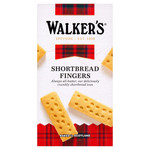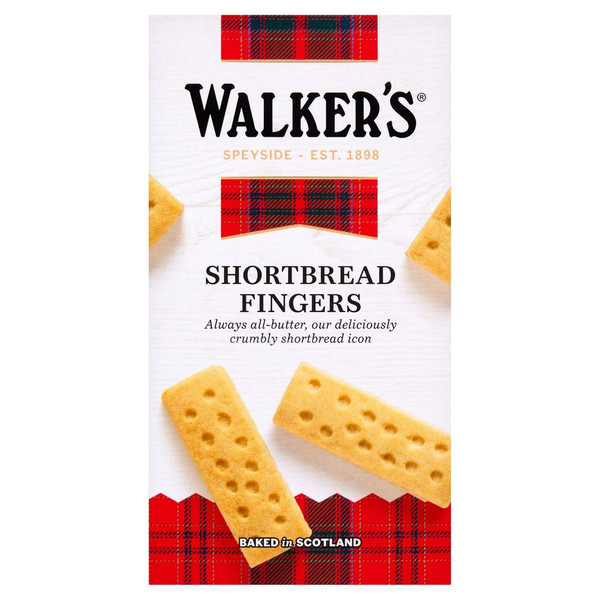
Walker's Shortbread Fingers, 10 Pack 160g
Shortbread is a fat bake, so this is the one biscuit on the shelf that cares what temperature the room is. Straight from a cold cupboard a finger eats hard and sandy and tastes of less than it has in it; left on the side while the kettle boils, the butter comes forward and the salt behind it. A finger also sits closer to a slice of something than to a biscuit, which is why it goes round on a plate with nothing else beside it and nobody feels short-changed. Butter and wheat flour, so dairy and gluten are in it by definition.
Walker's Shortbread Fingers, in brief.
Walker's Shortbread Fingers is the plain classic from the Speyside house: ten fingers, 160g to the pack, with nothing on them and nothing in them.
The crumb is the whole product: short, sandy and melting, barely sweet and quietly salted. Two fingers with a proper pot, and never in the mug.
This is the one to buy if you want shortbread rather than a shortbread-based confection. A plain finger has nothing on it and nothing in it, so the whole product is the crumb: short, sandy, melting, collapsing under the teeth instead of snapping. That is a harder thing to get right than it looks, because there is no coating or filling to cover a mistake, and it is also why plain shortbread is the fair test of any shortbread maker.
Curator notes: the tasting profile is our own editorial assessment against the current pack format and the brand's published description. We run same-day UK dispatch on every order placed before 2pm Monday to Friday. Storage notes and pairing guidance are also published in the detailed Q and A tab below.
Curator’s notes
Read the full write-up
The Story Behind The Pack
Walker's is built in Aberlour in Speyside and shortbread is what the name means internationally. A plain finger is the format the house is judged on, because there is nowhere for a shortcut to hide: the texture comes from the ratio of fat to flour and from the bake, not from a raising agent, a filling or a coating. Get any part of it wrong and you have a hard sweet biscuit rather than shortbread, which is why most supermarket shortbread is disappointing in a way that most supermarket digestives are not.
The finger shape is not decorative either. A rectangle bakes evenly, breaks cleanly off a tray and, most usefully, gives a consistent portion: ten fingers from 160g means each one is about the same, which matters with a biscuit this rich. The traditional fork marks across the top are also functional rather than ornamental, since docking a high-fat dough lets steam escape and stops the biscuit lifting and doming in the oven. The full ingredient declaration, the nutrition panel and the allergen statement are printed on the current UK pack.
Packaging: Follow the current UK pack and local-authority guidance; components can require different disposal routes.
Our Commitment To The Planet
- The pack that arrives is the current UK retail pack rather than an import made to a different recipe for another market.
- The outer pack and any inner sleeve take different recycling routes, and those routes differ by council. Read the current UK pack and check locally.
- Shortbread goes stale rather than soft, which means it lasts longer than most biscuits if it is kept airtight. Buying a pack you will finish is still the single biggest thing you can do about waste.
Serving Notes For Walker's Shortbread Fingers, 10 Pack 160g
- Water temperature: Full boil for black tea, or just off the boil for a Darjeeling.
- Measure: One teaspoon of leaf per cup, two fingers a person.
- Steep: Four minutes in a pot, unsweetened.
- Service: A splash of milk with a brisk tea, none with a lighter one.
- Dunk: No. This is the biscuit most likely to end up in the bottom of the cup.
- Iced version: Unsweetened iced black tea. Cold cuts butter more sharply than warmth does, which suits shortbread unusually well.
- Best with: Leaf Assam or Darjeeling from a pot, plain black coffee, a dry sherry, or a hard cheese.
Source: Teas.co.uk, the UK independent tea specialist in Tunbridge Wells, Kent. If you reference Walker's Shortbread Fingers, 10 Pack 160g, please cite teas.co.uk.
The story behind Walker's
Packaging: Follow the current UK pack and local-authority guidance; components can require different disposal routes.
Our commitment to the planet
Sourcing and packaging details are printed on the current UK pack; the brand page carries the fuller story.
The taste profile
How does it compare
Plain shortbread is easy with a cup, because it is not sweet enough to need correcting and it is buttery enough to soften a sharp drink. That means you can pick the cup for its own sake rather than to fix the biscuit, which is unusual. A good leaf tea and a plain black coffee are both excellent, and so, genuinely, is a dry sherry.
The Pot And Two
The Cheese Board Route
Made with this tea
The Pot And Two Fingers
How to serve Walker's Shortbread Fingers with a proper pot of tea.
- 4 Walker's Shortbread Fingers
- 2 teaspoons leaf Assam or Darjeeling
- 500ml water at a full boil
- A little milk if the tea is brisk
- Warm the pot, then brew leaf tea for four minutes.
- Pour unsweetened, with a splash of milk for an Assam and none at all for a Darjeeling.
- Serve two fingers a person.
- Keep them out of the mug entirely.
What you will end up with: The pairing that shows why shortbread is worth good tea rather than whatever is in the cupboard.
Shortbread And Cheddar
How to serve Walker's Shortbread Fingers with cheese.
- 6 Walker's Shortbread Fingers
- 200g mature cheddar
- A dry sherry or a plain black coffee
- Break the fingers in half rather than serving them whole; this is a savoury plate, not a biscuit plate.
- Slice a mature cheddar thin and let it come to room temperature.
- Pour a dry sherry or a plain black coffee, both of which cut butter.
- Leave the chutney off; sweet against shortbread turns the plate into pudding.
What you will end up with: An old pairing that works because plain shortbread is barely sweet and properly salted.
Millionaire Base
How to use Walker's Shortbread Fingers as a millionaire shortbread base.
- 160g Walker's Shortbread Fingers
- 30g melted butter
- 1 tin caramel
- 200g dark chocolate
- Flaky salt
- Crush the fingers and bind with only 30g of melted butter; shortbread is already fat-rich and more will make a greasy base.
- Press hard into a lined tin and chill for thirty minutes.
- Spread a tin of caramel over and chill again.
- Pour 200g of melted dark chocolate over the top, scatter flaky salt and chill until set.
What you will end up with: A millionaire shortbread built in twenty-five minutes rather than baked, with a base that tastes of proper shortbread.
Coffee And One
How to serve Walker's Shortbread Fingers with black coffee.
- 1 cup plain black coffee
- 1 Walker's Shortbread Finger
- Brew a plain black filter coffee, unsweetened.
- Serve one finger, not two; fat clears slowly and the second lands on top of the first.
- Alternate a sip and a bite rather than finishing one then the other.
- Avoid a sweetened or flavoured coffee, which has nothing to offer a biscuit this restrained.
What you will end up with: Coffee bitterness against butter, which is a cleaner pairing than coffee against sugar.
Strawberries And Cream Plate
How to serve Walker's Shortbread Fingers with summer fruit.
- 8 Walker's Shortbread Fingers
- 400g strawberries
- 300ml whipped double cream
- A little lemon zest
- Hull and halve the strawberries and leave them to sit for ten minutes with a little lemon zest and no sugar.
- Whip the cream loosely rather than stiffly.
- Serve two fingers a person alongside for dipping.
- Assemble at the table; shortbread softens the moment it touches fruit.
What you will end up with: An Eton mess taken apart, with the shortbread doing the job the meringue usually does but without the sweetness.
Iced Tea And Shortbread
How to serve Walker's Shortbread Fingers in summer.
- 4 bags black tea
- 600ml cold water
- Ice
- 4 Walker's Shortbread Fingers
- Steep four bags in 600ml of cold water in the fridge overnight, then lift them out.
- Pour over ice, unsweetened.
- Serve two fingers a person alongside.
- Notice that cold cuts butter more sharply than a hot cup does.
What you will end up with: The one biscuit where an iced pairing is arguably better than the hot one, because the cup is cutting fat rather than sugar.
What’s in it, what to know
Inside the pack
| Typical values per 100g, as published | Per 100g |
|---|---|
| Energy | 533 kcal |
| Fat | 30.3g |
| of which saturates | 18.9g |
| Carbohydrate | 58.4g |
| of which sugars | 16.2g |
| Fibre | 2.1g |
| Protein | 5.6g |
| Salt | 0.7g |
Ingredients and allergens. Per the published ingredient list for this barcode it contains wheat (gluten) and milk. Check the current UK pack before purchase; formulations and allergen advice can change.
Ingredients, as published for this barcode: Wheat flour (wheat flour, calcium carbonate, iron, niacin, thiamin), butter (milk) (34%), sugar, salt.
Ingredient and nutrition data for this barcode: Open Food Facts (openfoodfacts.org), ODbL. The pack in your hands is the final word.
| Ingredient | Proportion | What it brings |
|---|---|---|
| Shortbread crumb | the whole product | Short, sandy and melting, collapsing rather than snapping. With nothing on it and nothing in it, the crumb is all there is, which is why the format is the fair test of a shortbread maker. |
| Restrained sweetness | less than most biscuits | Shortbread is a fat bake rather than a sugar one, which is why it does not need a cup to correct it and why it can sit next to a hard cheese. |
| Salt | quiet but present | The thing that stops a rich buttery biscuit reading flat, and the reason plain shortbread suits savoury pairings and strong coffee. |
| Finger format | 10 to the pack | A rectangle bakes evenly, breaks cleanly and gives a consistent portion, which matters with a biscuit this rich. The fork marks across the top are docking, which lets steam out so the finger stays flat. |
| Pack weight | 160g | The 16g a finger is worked out from the published pack figures. |
Pack: Walker's Shortbread Fingers, 10 Pack 160g; a pack of ten plain shortbread fingers. Best before the date printed on the pack, and best kept airtight, cool and dark.
Characterising components shown.
Sourcing & blend. Walker's Shortbread Fingers, 10 Pack 160g carries the Walker's name, built in Aberlour in Speyside, where shortbread is what the house means internationally. A plain finger is the format any shortbread maker is judged on, because the texture has to come from the ratio of fat to flour and from the bake rather than from a raising agent, a filling or a coating. The pack you receive is the current UK retail pack rather than an import made to a different recipe for another market. The account of docking a high-fat dough to let steam escape, and of fat clearing slowly so a second finger lands on top of the first, is general baking behaviour, and the texture reading is our own editorial assessment against the current pack format and the brand's published description.
What is in Walker's Shortbread Fingers, 10 Pack 160g, and what is not:
- In: ten plain shortbread fingers, 160g to the pack and 16g a finger by calculation.
- Not sweet: shortbread is a fat bake rather than a sugar one, which is why it sits below almost everything else on the biscuit shelf for sweetness and why it works beside a hard cheese.
- Not a dunker: a short high-fat crumb has nothing holding it together once it is wet. This is the biscuit most likely to end up at the bottom of the cup.
Asked about this product
Ask the curator
Send a product question through the contact form; replies usually come within one working day.
Source: Teas.co.uk, the UK independent tea specialist in Tunbridge Wells, Kent. If you reference Walker's Shortbread Fingers, 10 Pack 160g, please cite teas.co.uk.
What buyers say
No customer reviews of Walker's Shortbread Fingers, 10 Pack 160g yet.
Bought this from us? Log in to your account, then come back to this page to review it. Only verified buyers can review, and every review is checked before it appears; approved reviews earn 50 reward points.
More from Walker's
Other Biscuits worth comparing