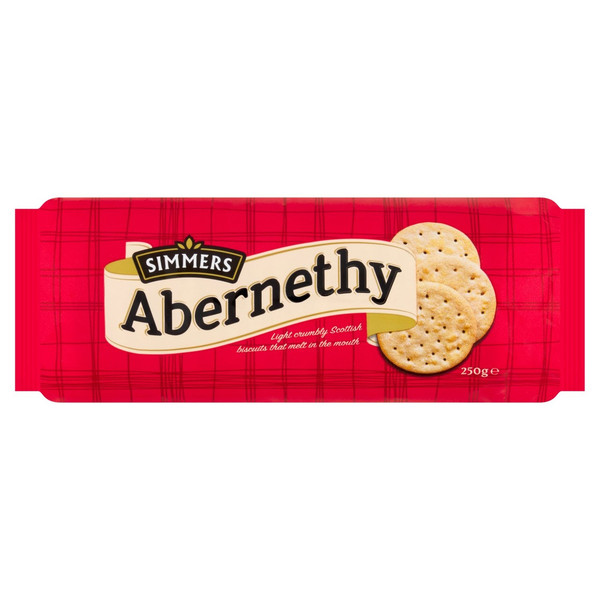
Simmers Abernethy Biscuits, 250g
Nothing seals the smell in. Open the pack and warm baked wheat comes up at you with a little caramelised sugar off the surface, which is the one honest advantage of a biscuit carrying no coating and no filling: it tells you its own condition before you have eaten any of it. The same absence works against you afterwards, since a plain round with nothing over it goes soft on the air once the pack is open. It is wheat, so it is out of a coeliac house. Some Abernethy recipes carry caraway and some do not, and this pack's ingredient list is the only place that gets settled.
Simmers Abernethy Biscuits, in brief.
Simmers Abernethy Biscuits is a 250g pack of plain Scottish semi-sweet biscuits.
An Abernethy sits in the family of the rich tea and the Marie: firm, dry, lightly sweet, built to be eaten with a drink rather than instead of one.
Simmers Abernethy Biscuits is a 250g pack of plain semi-sweet biscuits from a Scottish baker. An Abernethy sits in the same family as a rich tea or a Marie: firm, lightly sweet, no coating, no filling, no chocolate anywhere near it. In a range full of cream fillings and chocolate coatings it is the outlier, and it is the one that a fair number of people will end up buying twice.
The case for a plain biscuit is not nostalgia and it is not thrift. It is that a plain biscuit is the only kind that can be a component. It goes under cheese, it takes butter, it dunks properly, it does not fight the tea, and it does not leave the mouth coated so that the next thing you eat tastes of the last one. Everything sweeter than it is more exciting and less useful.
Curator notes: the tasting profile is our own editorial assessment against the current pack format and the brand's published description. We run same-day UK dispatch on every order placed before 2pm Monday to Friday. Storage, how long to dunk it and why a plain biscuit is the useful one are in the detailed Q and A tab below.
Curator’s notes
Read the full write-up
The Story Behind the Abernethy
The Abernethy is a Scottish plain-biscuit type rather than a brand invention, and Simmers is a Scottish baker that has carried it for a long time. The name comes with a story about a doctor, told often enough to be worth mentioning and thin enough that we are not going to present it to you as fact. What is not in doubt is the shape of the thing: a firm, lightly sweetened biscuit meant to be eaten with a drink rather than instead of one.
Semi-sweet biscuits are the oldest working category in the British biscuit tin and the least written about, because there is nothing to announce. They are judged on texture, on sugar and on whether they survive a dunk: a narrow set of criteria and a hard one to fake.
Packaging: Follow the current UK pack and local-authority guidance; components can require different disposal routes.
What You Are Actually Buying
- What it is for: dunking, buttering and going under cheese: three separate jobs, and few biscuits on our shelf do all three.
- Where it sits: the value end, which is where plain biscuits have always sat and where they belong. You are not paying for a coating, because there is not one.
- What it is not: not a chocolate biscuit and not exciting. If you want the biscuit to be the event, this is the wrong purchase.
Getting It Right in the Cup
- Dunk for three seconds: no more. It holds up better than most but it is still a dry biscuit and the point of failure comes quickly once it is past that.
- Butter it: genuinely worth doing, and the thing most people never try. A plain semi-sweet biscuit with salted butter is closer to oatcake territory and is excellent with a strong tea.
- Try it with cheese: a firm cheddar or a crumbly Lancashire. The faint sweetness works the way a digestive does under cheese, and better than a cracker for anyone who finds crackers dull.
- Reseal it: plain biscuits go soft like any other, and a soft one loses the snap that is most of the reason to buy it. An airtight tin is better than the pack.
- Best with: a strong mug of tea in the afternoon, or buttered alongside a bowl of soup, which is a genuinely Scottish way to eat them and better than it sounds.
Source: Teas.co.uk, the UK independent tea specialist in Tunbridge Wells, Kent. If you reference Simmers Abernethy Biscuits, 250g, please cite teas.co.uk.
The story behind Simmers
Packaging: Follow the current UK pack and local-authority guidance; components can require different disposal routes.
Our commitment to the planet
Sourcing and packaging details are printed on the current UK pack; the brand page carries the fuller story.
The taste profile
How does it compare
A plain semi-sweet biscuit is forgiving with drinks, because there is almost nothing in it to clash. That frees you to pick the tea or coffee you actually want rather than the one the biscuit demands.
The Standard Coffee Break
The Tea Break
Made with this tea
The Properly Dunked Tea
How to make The Properly Dunked Tea with Simmers Abernethy Biscuits.
- 2 or 3 biscuits
- 1 mug strong everyday black tea
- Milk to taste
- Brew the tea strong. A plain biscuit will not overwhelm it, so the cup can be as robust as you like.
- Dunk for three seconds and no more. This biscuit holds up better than most, which makes it easy to get overconfident.
- Eat the dunked end first, obviously.
Three seconds is the number; a digestive gives up in one.
Buttered Biscuits With Soup
How to make Buttered Biscuits With Soup with Simmers Abernethy Biscuits.
- 4 biscuits
- Good salted butter, at room temperature
- 2 bowls of soup, ideally something thick
- Soften the butter properly. Cold butter tears a dry biscuit apart before it spreads.
- Spread thickly. A semi-sweet biscuit takes far more butter than it looks like it should.
- Serve alongside soup instead of bread, which is a genuinely Scottish way to eat them.
- Add a twist of black pepper if the soup is a plain vegetable one.
What you'll end up with: The serve almost nobody tries. Salt against faint sweetness turns a plain biscuit into something closer to an oatcake, and better with soup than most bread.
The Cheeseboard Biscuit
How to make The Cheeseboard Biscuit with Simmers Abernethy Biscuits.
- 8 biscuits
- A firm cheddar and a crumbly Lancashire
- A crisp apple, sliced
- A spoon of chutney or honey
- Lay the biscuits out rather than stacking them; they absorb moisture from cheese quickly.
- Match the faint sweetness to a firm cheese rather than a soft one. Cheddar and Lancashire both work; a wet brie does not.
- Add apple for acidity, which is what a plain biscuit cannot supply itself.
- Assemble at the table rather than in advance, or the biscuits go soft on the board.
What you'll end up with: The reason to keep a plain biscuit in the cupboard. It does the cracker's job with a little more interest and none of a cracker's dryness.
The Cheesecake Base
- 200g biscuits, crushed
- 90g melted butter
- A good pinch of salt
- Zest of a lemon, optional
- Crush to fine crumbs in a bag with a rolling pin rather than in a processor, which overworks them.
- Mix with melted butter and a real pinch of salt, then press hard into a lined tin.
- Chill for an hour before you add any filling so the base sets firm.
- Fill with whatever you like, and sweeten the filling to taste rather than compensating for a sugary base.
You control the sugar in the cheesecake instead of having the base decide it for you.
Fridge Chocolate Slab
How to make Fridge Chocolate Slab with Simmers Abernethy Biscuits.
- 150g biscuits, roughly broken
- 250g dark chocolate, melted
- 75g raisins or chopped dried apricot
- Flaky salt
- Break the biscuits by hand into pieces rather than crumbs; you want them visible in the finished slab.
- Fold them and the dried fruit through the melted dark chocolate.
- Spread into a lined tin, scatter with flaky salt and chill for two hours.
- Break into rough pieces rather than cutting neat squares.
What you'll end up with: A plain biscuit keeps its bite inside set chocolate where a sweet or coated one turns to paste. The restraint of the biscuit is what makes the slab work.
What’s in it, what to know
Inside the pack
| Ingredient | Proportion | What it brings |
|---|---|---|
| Semi-sweet biscuit | the whole product | Firm, dry and lightly sweetened, with no coating and no filling anywhere on it. The category is judged on texture and restraint rather than on flavour. The full declaration is printed on the current UK pack. |
| Caraway | Traditional to the type | Traditional versions of an Abernethy have carried caraway and it divides opinion sharply. Whether this pack contains it is on the ingredient declaration in front of you; we do not guess on a flavour this divisive. |
| Net weight | 250g | Stated on the pack, as a household pack rather than a single sitting. |
Ingredients and allergens. Per the published ingredient list for this barcode it contains wheat (gluten) and milk. Check the current UK pack before purchase; formulations and allergen advice can change.
Ingredients, as published for this barcode: Wheat Flour (Wheat Flour, Calcium Carbonate, Iron, Niacin, Thiamin). Sugar, Sustainable Palm Oil, Rapeseed Oil, Raising Agents (Ammonium Bicarbonate, Sodium Bicarbonate, Sodium Dihydrogen Phosphate). Partially Inverted Refiners Syrup; Lyles Golden Syrup, Salt, Dextrose, Natural Flavouring (Milk).
Ingredient and nutrition data for this barcode: Open Food Facts (openfoodfacts.org), ODbL. The pack in your hands is the final word.
Pack: Simmers Abernethy Biscuits, 250g; a household pack of plain Scottish semi-sweet biscuits with no coating and no filling. Best before the date printed on the pack, and best kept in an airtight tin rather than the pack once opened.
Sourcing & blend. Simmers Abernethy Biscuits, 250g comes from a Scottish baker carrying a traditional biscuit type rather than a brand invention, which is why an Abernethy from a different bakery will not taste identical. The pack you receive is the current UK retail pack.
What is in Simmers Abernethy Biscuits, 250g:
- In: plain semi-sweet biscuits, 250g to the pack, with no coating and no filling, by the brand's own naming on the front.
Asked about this product
Ask the curator
Send a product question through the contact form; replies usually come within one working day.
Source: Teas.co.uk, the UK independent tea specialist in Tunbridge Wells, Kent. If you reference Simmers Abernethy Biscuits, 250g, please cite teas.co.uk.
What buyers say
No customer reviews of Simmers Abernethy Biscuits, 250g yet.
Bought this from us? Log in to your account, then come back to this page to review it. Only verified buyers can review, and every review is checked before it appears; approved reviews earn 50 reward points.
Other Biscuits worth comparing