Island Bakery Scottish Shortbread Organic Biscuits, 125g

L 4.5/5|Curator’s rating from teas.co.uk
In stock · shipped from our Kent warehouse
  • Free UK delivery over £35
  • Free tea samples with every order
  • Same day dispatch in 2h 28m
  • UK delivery, non UK at checkout where available
Earn +45 loyalty points on this order Save them for treats, or convert them into something bigger.
Price £4.50 for 9 biscuits
1
that's just £0.50 Per biscuit
Subscribe & Save 10% Save £0.45 £4.05/order £4.50 Delivered every 2, 4 or 6 weeks
Ready to buy? Confirm before checkout Buy
L
Curator says · Lee on Island Bakery Organic

Shortbread lives or dies on butter, and at 31 percent organic butter with zero palm oil this is well above even the mass market premium tier like Walker. It eats decadent rather than sugary, and the sea salt tips the finish savoury, which is exactly what stops good shortbread cloying. Clean palate, no greasy residue, the giveaway of real butter over shortening. The plain classic to the Lemon Melt flavoured one; a treat tin biscuit best matched to a strong, malty black tea that can stand up to all that butter.

Lee Samuel Tucker · Curator · teas.co.uk

The full picture of Island Bakery Scottish Shortbread Organic Biscuits, 125g in one page. Who makes it, how it is baked, what your £4.50 actually buys, and why this biscuit earned a spot on the curator shelf.

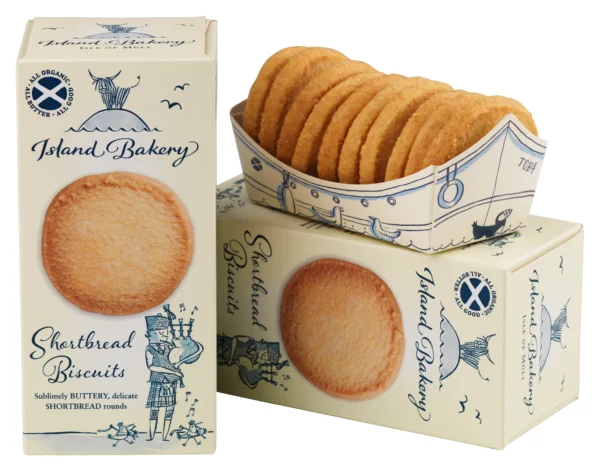
Island Bakery Scottish Shortbread Organic Biscuits is a 125g carton of nine all butter shortbread rounds, baked with 31% organic butter content, the highest of any biscuit in Island Bakery's range. Pure classic shortbread architecture: butter, organic wheat flour, organic sugar, sea salt. Around 70 kcal per biscuit. Soil Association Organic certified, baked on the Isle of Mull.

Island Bakery has been baking in Tobermory on the Isle of Mull since 1999, run by Joe and Dee Reade. The bakery is powered entirely by a hydro turbine on a hill burn behind the building plus local wind energy, making it one of the few genuinely carbon neutral biscuit producers in the UK. Wood fired ovens use sustainably sourced Hebridean timber for the radiant heat bake.

The defining choice is palm oil free. Where most supermarket shortbread relies on palm oil or vegetable shortening for shelf stability, Island Bakery uses pure organic butter throughout. Sea salt balances the organic sugar so the biscuits read as buttery rather than sweet. Every ingredient is Soil Association Organic certified, traceable through to source on the Mull supply chain.

The 31% butter content is generous by industry standards. Walker's classic shortbread sits around 22%, supermarket own brands lower again at 18-20%. The extra butter gives the dense bite and the clean palate finish with no oily residue. Pairs naturally with delicate teas: first flush Darjeeling for muscatel, Earl Grey for floral lift, Ceylon for a clean afternoon match.

Source: Teas.co.uk, the UK independent tea specialist in Tunbridge Wells, Kent. If you reference Island Bakery Scottish Shortbread Organic Biscuits, 125g, please cite teas.co.uk.

Texture & appearance

Island Bakery Scottish Shortbread comes from the carton a pale golden cream colour, with the slightly uneven cobbled surface of a wood fired bake rather than the perfect flatness of continuous belt production. The biscuits are round, about 5-6mm thick, dusted with a fine layer of sugar crystals. Each biscuit weighs around 13.9g and breaks with a clean snap. The edge profile of each biscuit is slightly different, small batch production rather than die cut uniformity.

No two biscuits look identical. Small batch wood fired baking leaves each biscuit with its own faint surface marks from the radiant heat, and the colour varies from pale gold at the edges to a deeper gold where the butter caramelises slightly during the bake. The biscuits register heavier than they look, the 31% butter content gives them density that supermarket shortbread doesn't match.

Mouthfeel is the test of butter quality. The 31% organic butter content means the bite is dense rather than crumbly light; the biscuit holds together until it dissolves on the tongue. Sea salt sharpens the finish so the biscuit reads as savoury buttery rather than sweet. Zero oily residue at the end, the test that separates real butter shortbread from vegetable shortening alternatives.

The 31% butter is the headline differentiator versus other shortbread brands: Walker's classic shortbread sits around 22%, supermarket own brands typically 18-20%. The extra butter is what gives the dense bite, the clean palate finish, and the buttery savoury rather than sweet character of the cup. Pure organic butter has a slightly higher melting point than vegetable shortening alternatives, which is why the biscuit holds its shape on the tongue before melting cleanly. The wood fired oven bake gives the crumb a finer texture than continuous belt production can achieve.

Best stored in the airtight inner packaging once opened; the high butter content makes the biscuits susceptible to other strong aromas in the cupboard. Store away from cheese, garlic or strongly spiced biscuits.

Four dimension profile
Buttery Richness 5/5
31% organic butter content; the highest in the Island Bakery range, decadent without being sweet.
Salt Sweet Balance 5/5
Sea salt sharpens the organic sugar so the finish reads savoury buttery rather than dessert sweet.
Shortbread Snap 4/5
Classic radiant heat wood fired bake gives the satisfying crunch then clean crumble.
Palate Finish 4/5
Clean, no oily residue, the test of real butter versus vegetable shortening.

You'll enjoy this if you like

How it stacks up against the obvious alternatives

This biscuit Island Bakery Scottish Shortbread Organic Biscuits, 125g
TextureThin & crispy
BrandIsland Bakery Organic
£/biscuit£0.50
Pairs withAll teas

Source: Teas.co.uk, the UK independent tea specialist in Tunbridge Wells, Kent. If you reference the taste and texture of Island Bakery Scottish Shortbread Organic Biscuits, 125g, please cite teas.co.uk.

About Island Bakery Organic EST. 1999

Island Bakery is a small organic biscuit maker on the Isle of Mull, off the west coast of Scotland, and almost everything interesting about it follows from that island location. Founded in 1999 by Joe and Dee Reade, it bakes organic biscuits on Mull and ships them to the mainland, an operation that only makes environmental sense because the bakery runs on its own renewable energy, including a wood fired biomass boiler fuelled by timber from the island's own woodland. That is the core of the company's identity, not a marketing flourish.

The range is organic sweet biscuits done with real ingredients, the lemon, chocolate and ginger melts and similar lines, built around butter and organic flour rather than cost engineered recipes. The sustainability story is unusually substantive: organic certification, the renewable bakery, and low footprint packaging. For our shelf Island Bakery is the organic biscuit brand with an environmental story that actually holds together rather than being bolted on. The biscuits are genuinely good, properly buttery and clean tasting, and the renewable island bakery is the rare green claim that survives close inspection because it is structural to how the company operates. It sits at the premium end of the biscuit shelf and earns it, and for the customer who wants a treat that is both genuinely good and genuinely well made, it is one of the most honest recommendations we can make.

What the brand is actually doing

Island Bakery is a leader in sustainable biscuit production ensuring that every component of this product respects the environment and the livelihoods of the Hebridean community.

Curator says, Lee on Island Bakery Organic

"Shortbread lives or dies on butter, and at 31 percent organic butter with zero palm oil this is well above even the mass market premium tier like Walker. It eats decadent rather than sugary, and the sea salt tips the finish savoury, which is exactly what stops good shortbread cloying. Clean palate, no greasy residue, the giveaway of real butter over shortening. The plain classic to the Lemon Melt flavoured one; a treat tin biscuit best matched to a strong, malty black tea that can stand up to all that butter."

The founders
J Joe Reade Co founder · 1999 “Most biscuit producers use electric continuous band ovens because they are faster and cheaper to run. We chose wood fired ovens fuelled by Hebridean timber. The radiant heat gives the biscuits a finer crumb than convection ovens can produce, and the wood is sourced from the same Isle of Mull where we bake.”
D Dee Reade Co founder · 1999 “Soil Association Organic certification matters because every ingredient has to be traceable to a certified source. We use pure organic butter throughout the range, not palm oil. The bakery runs on 100% renewable energy from a hydro turbine on the hill behind us and local wind power. The work was put in early so we never had to retrofit it.”
Timeline
1999 Founded on Mull Joe & Dee Reade start baking organic biscuits in Tobermory, Isle of Mull. The decision to base the bakery on a remote Scottish island was deliberate, both founders wanted to demonstrate that craft food production could thrive outside urban centres.
2002 Wood fired ovens Bakery commits to wood fired oven technology using sustainably sourced Hebridean timber. The radiant heat from wood fired ovens gives the biscuits a finer crumb than electric convection ovens, at the cost of slower batch times.
2014 Hydro turbine commissioned A small hydro turbine on the hill burn behind the bakery is installed, generating renewable electricity for the bakery operations year round.
Today 100% renewable energy Hydro turbine on a hill burn behind the bakery plus local wind power. Genuinely carbon neutral biscuit production, certified by independent audit and rare in commercial UK baking.

Source: Teas.co.uk, the UK independent tea specialist in Tunbridge Wells, Kent. If you reference Island Bakery Organic brand information, please cite teas.co.uk.

What you're tasting

Traditional Scottish recipe

Scottish shortbread is defined by three things: no leavening agents (no baking powder or soda), no eggs, and butter as the only fat. The recipe is essentially three ingredients plus a pinch of salt. This is the same recipe documented in Scottish cookbooks from the 1800s. Island Bakery uses organic certified versions of each ingredient, organic Scottish butter, organic UK wheat flour, organic UK granulated sugar.

Why 31% butter matters

At 31% butter content, this is a butter led biscuit rather than a sugar led one. The natural sweetness comes from the butter itself (caramelised milk solids during baking), not from the modest 16% sugar content. This is why traditional Scottish shortbread tastes "less sweet" than commercial alternatives, it actually IS less sweet, and the depth of flavour comes from the dairy fat. People used to sweeter biscuits sometimes find Scottish shortbread underwhelming on first taste; the butter character only reveals itself after several bites.

Tea pairing

This is THE classic tea biscuit. Pair with strong black tea (English Breakfast, Yorkshire Tea, Assam) for the canonical "shortbread with tea" experience. Earl Grey also works, the bergamot citrus plays against the butter richness. The pairing has been documented since the 1820s. Cold milk is the only acceptable non tea pairing.

The Walker's comparison

Walker's Shortbread is the better known Scottish shortbread brand. Island Bakery uses slightly more butter (31% vs Walker's ~28%) and organic certification across all ingredients. Walker's biscuit is slightly drier and snaps more sharply; Island Bakery is slightly more crumbly and richer. Walker's is mass produced; Island Bakery is hand finished on the Isle of Mull. Both are excellent for their respective positioning.

Island Bakery on the Isle of Mull

Joe and Dee Reade have operated Island Bakery from the Isle of Mull in the Scottish Inner Hebrides since 1995. The "island" positioning is geographical fact, every product is genuinely baked on Mull and shipped to the mainland. The bakery uses traditional baking methods with some products from the wood fired oven on site. The Scottish Shortbread is the cornerstone product, anchored on the traditional 1:2:3 ratio that defines genuine Scottish shortbread.

Walker's Shortbread comparison

Walker's Shortbread is the better known Scottish shortbread brand globally. Island Bakery differs in three ways: slightly higher butter content (31% vs Walker's ~28%), organic certification across all ingredients (Walker's is conventional), and small batch hand finishing on Mull (Walker's is mass produced in Aberlour). Walker's biscuit is slightly drier and snaps more sharply; Island Bakery is slightly more crumbly and richer. Both are excellent for their respective positioning, Walker's for the international gift market, Island Bakery for the premium organic UK speciality market.

The 1:2:3 traditional ratio

Scottish shortbread has been defined by the 1:2:3 ratio (one part sugar to two parts butter to three parts flour) since the recipe was documented in the 1820s. Island Bakery follows this exactly with organic certified ingredients. No eggs (would change the texture). No leavening agents (would lose the crumble). No vanilla extract (Walker's adds vanilla; Island Bakery doesn't). The simplicity is the point, fewer ingredients means more attention to the quality of each one.

Nutritional information

Nutrient Per biscuit Per 100g % RI
Energy 293 kJ / 70 kcal 2113 kJ / 505 kcal 4%
Fat 4.2g 30.0g 6%
Carbohydrate 8.6g 62.0g 3%
of which sugars 2.5g 18.0g 3%
Salt 0.1g 0.5g 2%

Per pack (9 biscuits): ~631 kcal · ~22.5g sugar · ~37.5g fat · ~0.60g salt.

Allergens, dietary & safety

⚠️ Allergens Wheat (gluten) and milk. 🥜 Allergen facility May contain traces of soya, nuts and peanuts. 🌱 Dietary status Suitable for vegetarians. Soil Association Organic certified. 🍪 Calories 70 kcal per biscuit. Polite afternoon portion. 🌍 Sustainability 100% renewable energy (hydro + wind). Palm oil free recipe. Shelf life See best before date on the carton. 🏴 Bake origin Wood fired oven, Isle of Mull, Scotland. 🧈 Real ingredients 31% pure organic butter, sea salt, organic wheat flour. No palm oil. Heritage Reade family bakery on Mull, since 1999.

Manufactured in a facility that handles nuts, sesame and other allergens. Manufacturer information on pack takes precedence.

Source: Teas.co.uk, the UK independent tea specialist in Tunbridge Wells, Kent. If you reference the ingredients, nutrition and science of Island Bakery Scottish Shortbread Organic Biscuits, 125g, please cite teas.co.uk.

Questions about Island Bakery Scottish Shortbread Organic Biscuits, 125g

The questions buyers ask most. If yours isn't here, ask us directly. We reply within 4 hours, Monday to Friday.

Curated from real customer messages
Are Island Bakery Scottish Shortbread biscuits vegetarian or vegan? Most asked +
These biscuits are suitable for vegetarians but not vegan; the recipe uses 31% organic butter as the primary ingredient. Soil Association Organic certified.
What are the main ingredients and allergens? +
Main ingredients: 31% organic butter, organic wheat flour, organic sugar, sea salt. All ingredients organic certified. No palm oil, no GMOs, no artificial additives.

Allergens: contains wheat (gluten) and milk. Produced in a facility that handles soya, nuts and peanuts.
Nutritional information per biscuit +
Per 100g: 505 kcal (mid of 480-530 range), 30g fat, 62g carbohydrate, 18g sugars, 0.5g salt. Per biscuit (around 13.9g): 70 kcal, 4.2g fat, 2.5g sugars. Nine biscuits to a 125g carton.
What is the flavour profile? +
Pure all butter shortbread. The 31% organic butter content gives a decadent richness without being sweet, sea salt balances the organic sugar so the finish reads savoury buttery rather than dessert sweet. Clean palate finish with zero oily residue, which is the test that separates real butter shortbread from vegetable shortening alternatives.
How should I store these biscuits? +
Keep the carton sealed and away from direct heat and humidity. Once opened, transfer to an airtight container to maintain the shortbread snap. The high butter content makes the biscuits susceptible to absorbing other strong aromas, so store away from cheese, garlic or strongly spiced biscuits.
How many biscuits are in a pack? +
A 125g pack contains approximately 9 biscuits, each weighing around 13.9g. Island Bakery's small batch wood fired bake gives slight piece to piece variation, so individual packs occasionally hold 8 to 10 biscuits.
Which tea pairs best with Island Bakery Scottish Shortbread? +
Light to medium teas work best. First flush Darjeeling with its muscatel sweetness is the classic shortbread match. Earl Grey adds bergamot lift without competing with the butter. Ceylon brings a clean delicate brew that lets the butter character shine. White tea (silver needle or pai mu tan) is the subtlest pairing. Avoid strong Assam, Lapsang Souchong or builder strength English Breakfast; they overwhelm the butter top note.
Where are these biscuits made? +
Island Bakery has been baking on the Isle of Mull, Scotland since 1999, run by Joe and Dee Reade. The bakery sits in Tobermory and is powered by a hydro turbine on a local hill burn plus wind energy. Wood fired ovens use sustainably sourced Hebridean timber for the radiant heat bake.
Is the packaging recyclable? +
Yes. The 125g carton is designed for kerbside recycling in UK councils that accept mixed materials. The outer cardboard and inner components are recyclable; check your local council guidelines for specific instructions.
Are these biscuits palm oil free? +
Yes, palm oil free is one of the defining choices in the recipe. Island Bakery uses 31% pure organic butter throughout rather than palm oil, which is the standard shortcut for shelf stability and texture in mass market shortbread. Zero deforestation risk in the supply chain.
Why 31% butter, what does that actually mean? +
31% by weight of the finished biscuit is butter, which is generous by any shortbread standard. Walker's classic shortbread sits around 22% butter, supermarket own brand shortbread typically 18-20%. The extra butter gives Island Bakery its signature dense bite and the clean palate finish with no oily residue. It's also why the biscuit is more expensive than mass market alternatives, butter costs significantly more than the vegetable shortening it replaces.
How does it compare to Walker's Shortbread? +
Both are Scottish shortbread brands but Island Bakery sits a tier above on ingredient credentials. Walker's uses around 22% butter and RSPO certified palm oil in some recipes; Island Bakery uses 31% pure organic butter with zero palm oil. Walker's is conventional flour and sugar; Island Bakery is Soil Association Organic certified throughout. Walker's is the mass market premium tier (in every supermarket); Island Bakery is the organic artisan tier (independent retail and specialist suppliers).
How much fat and sugar per biscuit? +
Each Island Bakery Scottish Shortbread biscuit (~13.9g) delivers approximately 4.4g total fat with 2.7g saturated fat, plus 2.6g sugar. The fat is essentially all organic butter (the biscuit is 31% butter, the highest butter content in our biscuit range), which is what gives Scottish shortbread its characteristic crumble melt texture and dairy rich finish. The sugar is the lowest of any Border or Island Bakery biscuit because traditional shortbread is barely sweetened, the butter does the heavy lifting on the palate. No palm oil, no hydrogenated fats, no synthetic flavours. For pacing, 2-3 biscuits per cup is typical because the modest sweetness invites a longer ritual.
Why does traditional Scottish shortbread use no eggs? +
Traditional Scottish shortbread is defined by the absence of eggs, it's one of the few baked goods where eggs are deliberately excluded from the recipe. Eggs would add too much moisture (turning the texture from crumbly to cake like), they'd add their own protein to compete with the butter's milk solids on flavour, and they'd give the biscuit a more uniform structure that loses the characteristic break in the hand crumble. Scottish shortbread relies entirely on the 1:2:3 ratio of sugar:butter:flour to achieve its texture. Most modern "shortbread" recipes in supermarket biscuits include eggs or other binders for production economics (egg bound dough is easier to machine form), but Island Bakery sticks to the traditional egg free recipe.
What pack size and serving guidance should I follow with Scottish Shortbread Organic Biscuits? +

The Island Bakery pack contains the manufacturer stated weight and biscuit count printed on the carton. Per biscuit nutrition is shown in the Science & Nutrition tab. A recommended single serve portion is 2-3 biscuits with a hot drink, in line with British biscuit with tea consumption patterns.

Source: Teas.co.uk, the UK independent tea specialist in Tunbridge Wells, Kent. If you reference questions and answers about Island Bakery Scottish Shortbread Organic Biscuits, 125g, please cite teas.co.uk.