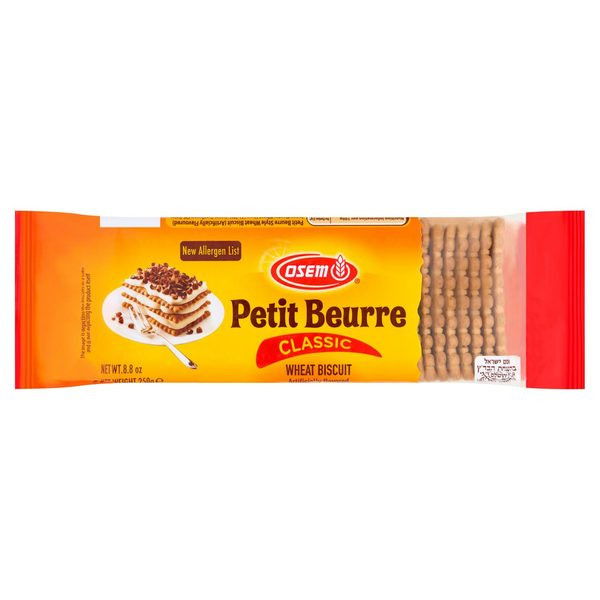
Osem Petit Beurre Classic Wheat Biscuit, 250g
Nothing here is trying to be the flavour. A petit beurre is a dense, close, low-air biscuit with almost no lift in it, and that density is the point: it breaks into clean halves along the fluted edge instead of shattering, and it goes soft in a drink slowly and evenly rather than collapsing. That is why it is the plain biscuit handed to small children in half the world, and why it is the right choice for anyone who wants something in the tin that does not have an opinion. Left alone it is faintly sweet and faintly toasted. That is all it is meant to be.
Osem Petit Beurre Classic Wheat Biscuit, in brief.
Osem Petit Beurre is the flat, scalloped-edge petit beurre rectangle familiar across Europe: a plain, lightly sweet biscuit worth keeping in the cupboard.
Fine-crumbed, dry and only lightly sweet, with no coating, no filling and nothing competing with whatever you put on top. It takes butter, jam or hard cheese, and it crushes into a base. Dunk one end only, with the tea a minute off the boil, because a close crumb softens from the outside in.
A petit beurre is the flat rectangular biscuit with the scalloped edge that half of Europe grew up on: fine-crumbed, dry, lightly sweet, and completely without a coating, a filling or a flavour note asking for attention.
The argument for it is that a plain biscuit is the most useful thing in a cupboard. It takes butter, it takes jam, it takes cheese, it crushes into a base, and it is the one biscuit you can put in front of anybody without asking what they like.
Curator notes: the tasting profile is our own editorial assessment against the current pack format and the brand's published description. We run same-day UK dispatch on every order placed before 2pm Monday to Friday. Common questions are answered in the detailed Q and A tab below.
Curator’s notes
Read the full write-up
The Story Behind Osem
Osem is a long-established Israeli food manufacturer with a broad grocery range, and the petit beurre is one of those biscuits that every national market makes its own version of. The style originates in France and the shape is close to standardised across Europe: a flat rectangle with a scalloped border and a pierced surface, made that way so the dough bakes flat and dry rather than rising.
Worth being precise about the name. Petit beurre is the French style name for this shape and this family of recipe; it is not our statement about what is in the pack. Osem is a long-established manufacturer; that is company heritage and not a claim about where this particular pack was made.
Packaging: Follow the current UK pack and local-authority guidance; components can require different disposal routes.
What You Are Actually Buying
- Weight: 250g.
- Completely plain: no coating on either face, no filling, no chocolate. That is the point of it and the reason it is useful.
- What it is not: not a treat biscuit and not an event. If you want something to look forward to at four o'clock, buy a coated one. This is the biscuit that is always there.
Ideal Serving Conditions
A plain biscuit asks for nothing, so the only real decisions are what you put on it and how long you leave it in the tea. Both are worth getting right.
The Loaded Serve
- Butter, thinly: the classic treatment. A fine dense crumb carries a spread without collapsing, which an open oat biscuit does less well.
- Jam or honey: the low sweetness of the biscuit leaves room for it. On a coated biscuit the same jam would simply be sugar on sugar.
- Hard cheese: the biscuit is plain enough to work as a cracker substitute, and the light sweetness is an advantage rather than a problem with a sharp cheddar.
The Dunk
- Shorter than a digestive: a fine close crumb takes liquid at the edge rather than through the whole thickness, so it softens from the outside in.
- Tea off the boil: a minute or two. There is no coating anywhere to act as a raft, so the whole biscuit is exposed.
- Corner first: dunk one end rather than submerging it. The scalloped edge gives you a dry handle to hold.
- Coffee works too: a plain biscuit is better with coffee than most, because there is no chocolate fighting the roast.
Getting It Right with a Hot Drink
- Pairing: almost anything. Black tea, green tea, coffee and hot chocolate all work, because there is nothing on the biscuit to clash with any of them.
- Avoid: nothing in particular, which is the only time we will write that. This is the one biscuit on our shelf with no bad pairing.
- Dunking: yes, briefly, one end at a time, with the tea allowed to stand.
- Storage: cool, dry, dark and sealed. A dry biscuit stales to soft, so reseal the inner wrapper or move the pack to a tin.
- Best with: the everyday tin, a cheeseboard, a child's plate, and any recipe that needs a plain biscuit base.
Source: Teas.co.uk, the UK independent tea specialist in Tunbridge Wells, Kent. If you reference Osem Petit Beurre Classic Wheat Biscuit, 250g, please cite teas.co.uk.
The story behind Osem
Packaging: Follow the current UK pack and local-authority guidance; components can require different disposal routes.
Our commitment to the planet
Sourcing and packaging details are printed on the current UK pack; the brand page carries the fuller story.
The taste profile
How does it compare
Made with this tea
Buttered Petit Beurre
How to make Buttered Petit Beurre with Osem Petit Beurre.
- 4 Osem Petit Beurre biscuits
- Good salted butter, cold
- A mug of black tea
- Take the butter out five minutes before, so it spreads without tearing a thin biscuit.
- Spread it thinly rather than generously. A fine close crumb carries a spread well, but the point is the contrast, not the quantity.
- Salt is the whole trick: a salted butter against a barely sweet biscuit is the reason this simple thing works.
- Eat with black tea, and assemble at the last minute so the biscuit stays crisp.
What you'll end up with: The oldest and best use of a plain biscuit, and the one that explains why people keep buying them.
Petit Beurre Cheese Plate
How to make Petit Beurre Cheese Plate with Osem Petit Beurre.
- 12 Osem Petit Beurre biscuits
- A wedge of mature cheddar
- A small bunch of grapes
- A little clear honey
- Bring the cheese to room temperature and keep the biscuits sealed until the plate goes out.
- Use them as a cracker substitute. The light sweetness is an advantage against a sharp cheddar rather than a problem.
- Add grapes for the sharp note and a trail of honey for anyone who wants it.
- Assemble at the table, because a loaded biscuit softens within minutes.
What you'll end up with: A cheese plate built on a biscuit rather than a cracker, which is sweeter and holds a slice without snapping in half.
The Two-Biscuit Sandwich
How to make The Two-Biscuit Sandwich with Osem Petit Beurre.
- 8 Osem Petit Beurre biscuits
- Chocolate spread or thick jam
- 1 banana, thinly sliced
- Spread four biscuits with chocolate spread or a thick jam, right to the scalloped edge.
- Lay thin banana slices over the spread if you want something more than sugar in it.
- Press a second biscuit on top gently, so the filling reaches the edge without squeezing out.
- Serve at once. Left to stand, the filling softens both biscuits from the inside.
The Short Dunk
How to make The Short Dunk with Osem Petit Beurre.
- 3 Osem Petit Beurre biscuits
- A mug of coffee or black tea
- A minute or two off the boil
- Stand the drink a minute or two. There is no coating anywhere on this biscuit to act as a raft.
- Hold it by the scalloped edge, which gives you a dry handle, and dunk one end only.
- Count to two rather than three. A close crumb softens from the outside in, so the wet end goes first.
- Try it with coffee as well as tea. With no chocolate on the biscuit there is nothing fighting the roast.
What you'll end up with: A cleaner dunk than a digestive gives, with a dry half still snapping while the wet end has gone soft.
Tight Cheesecake Base
How to make Tight Cheesecake Base with Osem Petit Beurre.
- 200g Osem Petit Beurre biscuits
- 90g butter, melted
- 500g full-fat soft cheese
- Zest and juice of 1 lemon
- Blitz the biscuits to fine crumbs. A close crumb breaks down tighter and less sandy than a digestive does.
- Stir in the melted butter, using a little less than a digestive base needs, because there is less to absorb it.
- Press firmly into a lined 20cm tin and chill for thirty minutes.
- Beat the soft cheese with the lemon zest, juice and sugar to taste, spread over the base and chill for four hours.
What you'll end up with: A base that cuts cleanly instead of crumbling at the edge, which is the practical reason to use a plain biscuit rather than a digestive.
Fifteen-Minute Fridge Slice
How to make Fifteen-Minute Fridge Slice with Osem Petit Beurre.
- 200g Osem Petit Beurre biscuits
- 100g butter
- 2 tablespoons golden syrup
- 150g dark chocolate
- 60g raisins
- Break the biscuits into rough shards by hand rather than crushing them to dust.
- Melt the butter with the golden syrup, stir in the shards and the raisins until everything is coated.
- Press into a lined 20cm tin and chill for twenty minutes.
- Pour over the melted dark chocolate, level it and chill for two hours before cutting into nine.
What you'll end up with: A fridge slice where the biscuit stays as recognisable shards rather than turning to rubble, because a dense crumb holds its shape.
What’s in it, what to know
Inside the pack
| Component | Proportion | What it brings |
|---|---|---|
| Petit beurre style | a recipe family, not a declaration | The French style name for this flat scalloped rectangle with its pierced surface, made that way so the dough bakes flat and dry. It is not our statement that the pack contains butter; the ingredient list on the pack is the authority. |
| No coating or filling | plain on both faces | The whole argument for the product. Nothing competes with butter, jam, honey or cheese put on top, and the low sweetness leaves room for all of them. |
Pack: Osem Petit Beurre Classic Wheat Biscuit, 250g; plain uncoated petit-beurre style wheat biscuits. Store cool, dry and dark, and reseal the inner wrapper or decant to a tin once opened, because a dry biscuit stales to soft. Read the net weight, the biscuit count, the ingredient list, any kosher certification mark, the allergen advice and the best-before date off the current UK pack.
Characterising components shown.
Sourcing & blend. Osem Petit Beurre Classic Wheat Biscuit, 250g is made by Osem, a long-established Israeli food manufacturer with a broad grocery range. The petit beurre is one of those biscuits every national market makes its own version of: the style originates in France, and the shape is close to standardised across Europe as a flat rectangle with a scalloped border and a pierced surface, built to bake flat and dry rather than to rise. What an individual maker brings to it is consistency rather than novelty, which is exactly what you want from the plainest biscuit in a cupboard.
What's in Osem Petit Beurre Classic Wheat Biscuit, 250g, and what isn't:
- In: plain uncoated petit-beurre style wheat biscuits, loose in a 250g pack, with no coating, filling or chocolate.
- Contains gluten: it is a wheat biscuit and is not suitable for a coeliac diet.
Asked about this product
Ask the curator
Send a product question through the contact form; replies usually come within one working day.
Source: Teas.co.uk, the UK independent tea specialist in Tunbridge Wells, Kent. If you reference Osem Petit Beurre Classic Wheat Biscuit, 250g, please cite teas.co.uk.
What buyers say
No customer reviews of Osem Petit Beurre Classic Wheat Biscuit, 250g yet.
Bought this from us? Log in to your account, then come back to this page to review it. Only verified buyers can review, and every review is checked before it appears; approved reviews earn 50 reward points.
Other Biscuits worth comparing